
Agroforestry, in Search of Tomorrow’s Viticulture – Mosnel 190
April 2026 marked the 190th anniversary of the Mosnel winery in Franciacorta. A major part of the celebrations was attending a conference about Mosnel’s Agroforestry project, which is the subject of this article.
Ten years ago, I was privileged to attend the celebrations of Mosnel’s 180th anniversary 1 This time, their 190th proved equally memorable because Mosnel shared their approach to creating a sustainable future at the conference. Although this was conducted in Italian, an excellent translation service ensured my participation and, hopefully, understanding. What follows is a short précis of what each speaker had to say, which, when taken together, form a kind of Manifesto.
The Agroforestry Conference
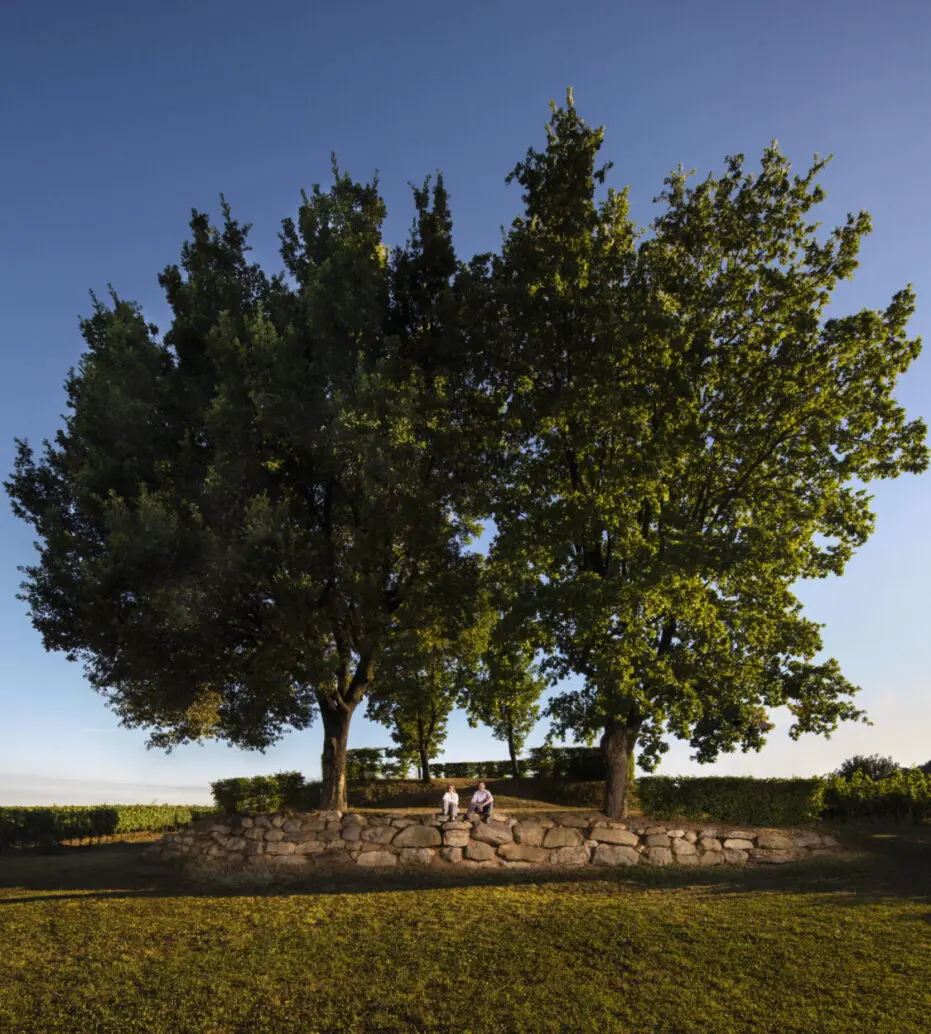
The conference was called “Agroforestry, in Search of Tomorrow’s Viticulture”. This topic is now central to Italian viticultural research, especially in light of the climate emergency. An Agroforestry project commenced at Mosnel ten years ago in collaboration with Sata Studio Agronomico, and, as we shall see, it’s gradually transforming Mosnel. Fittingly, the conference was held outside in the Mosnel vineyards, at the centre of its Biodiversity Path.
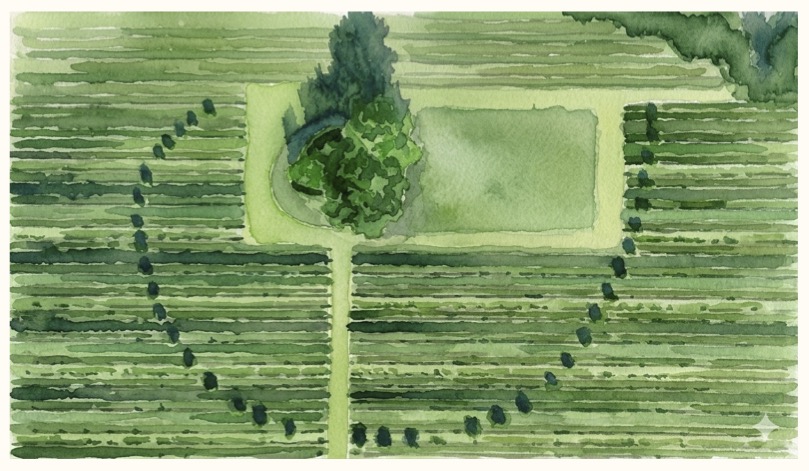
This Biodiversity Path combines green manure crops, an 800-metre-long hedgerow of native shrub species, and a spiral of 65 pairs of hornbeams and hawthorns planted in the Fibonacci sequence to give it an attractive visual impact 2. This new landscape ecosystem is monitored annually by Sata to assess biodiversity and soil fertility. Lucia and Giulio Barzanò, owners of Mosnel, explain this as follows;
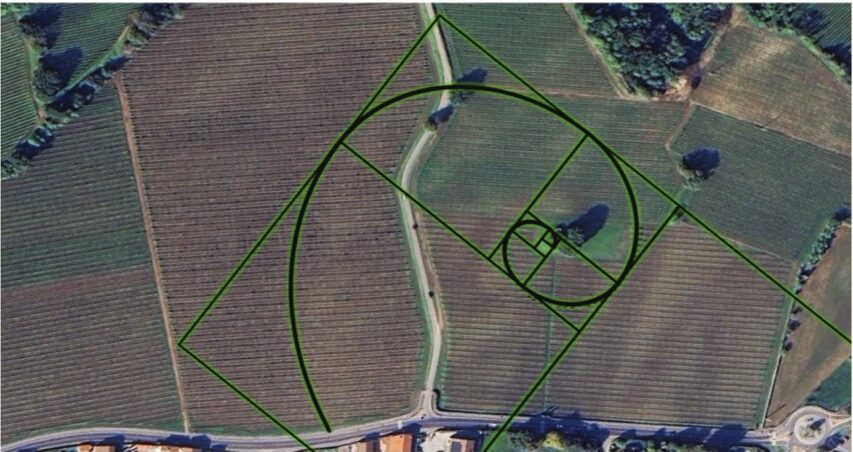
Biodiversity Path Plan using Fibonacci
“We grew up in the vineyards and learned from our mother [Emanuela Barzanò Barboglio, EBB] that they are a living ecosystem, to be studied, respected, and supported. We wanted to create the conditions for a genuine coexistence between the vine and living organisms – both plant and animal – that can protect and enhance the vineyards. Those who cultivate the land are custodians. This conference is our way of celebrating our 190th anniversary. We honour it with a multifaceted reflection that is open to voices from various disciplines.”
Actions as well as words
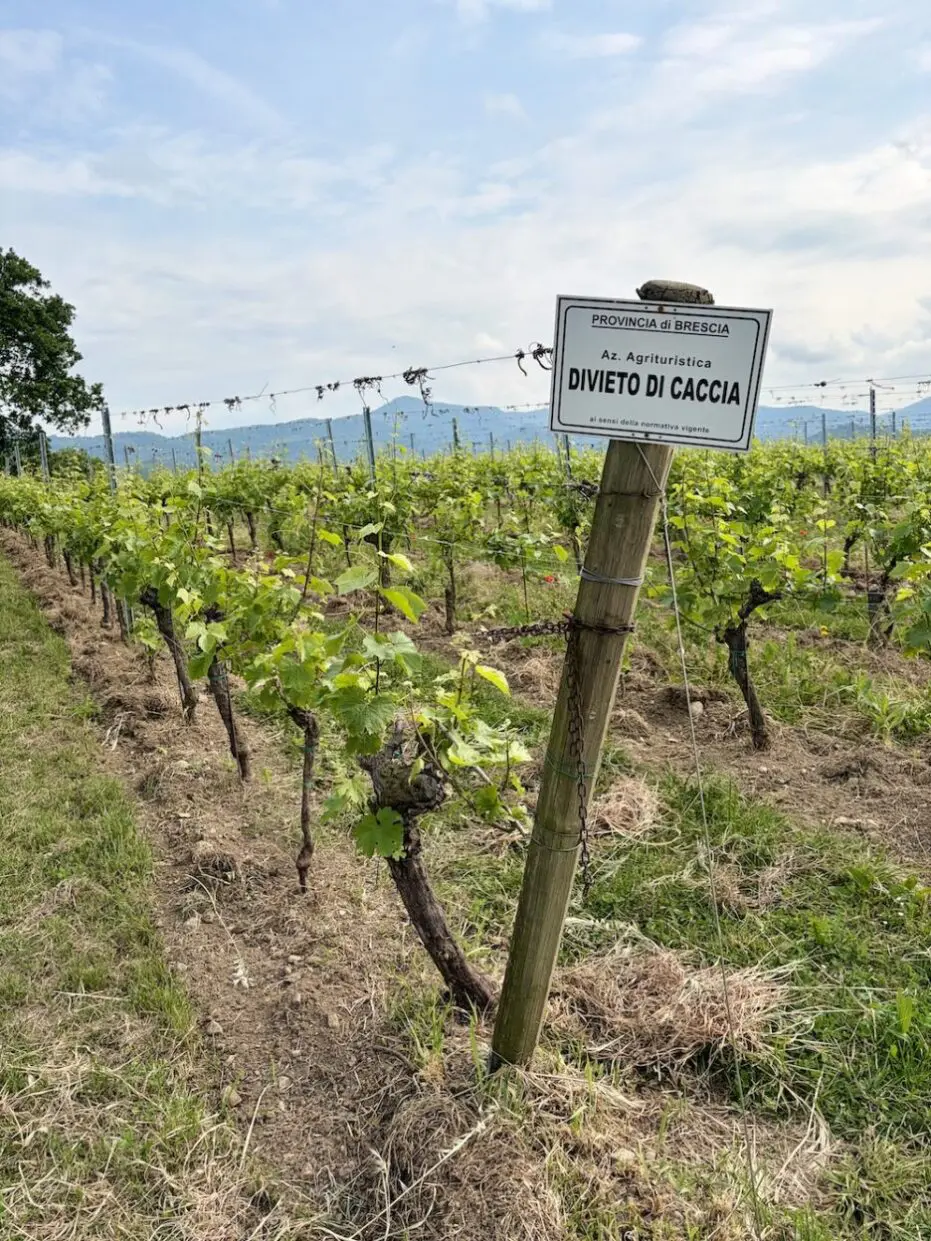
No Hunting
Mosnel is organic, certified by ValorItalia and, in an area known for hunting, has managed to get that practice banned from its estate lands (Divietto di Cacchia). Nevertheless, starting an agroforestry project was a decision that, at the time, was far from obvious.
Yet Lucia and Giulio Barzanò were among the first in Franciacorta to take such action because applying agroforestry principles to viticulture (vitiforestry?) brings concrete and measurable benefits. For example, the presence of trees mitigates climate extremes and environmental risks, improves water management, captures carbon, combats soil degradation and erosion, and increases organic matter and soil fertility. In sum, the vineyards become more resilient to climate change.
Agroforestry, moreover, transforms not only the soil and vines. It transforms the landscape, and thereby transforms the experience of those who live in the landscape or pass through it. The vineyard ecosystem becomes a more beautiful and welcoming landscape, and it’s also more visible.
This brings a sense of well-being to those who work there, those who visit it, and those who observe it. Neuroscience research confirms what we intuitively feel: that contact with such environments nourishes something deep within us. The Mosnel vineyard landscape is therefore not just a more resilient production system; it also enhances the well-being of people.
To explore these themes, the conference brought an audience and speakers from different disciplines together, hosted by Armando Castagno, writer and author. This suggests that the future of viticulture is built through a multi-stakeholder approach. One that integrates agronomy, landscape, ecology, and human well-being.
Over to the Speakers.
Pierluigi Donna – agronomist and founder of Sata Studio Agronomico
As an alternative to the relentless pursuit of new chemical compounds, we must instead strive to foster a balance among different forms of life. The technical, agronomic, and social objectives of the agroforestry project at Mosnel need to harmonise with the surrounding landscape and its aesthetic integrity and the history. This project will take more than one lifetime. Once the individual plant species were selected, the task was then to design their placement. Consequently, we drew inspiration from the Golden Ratio and the Fibonacci sequence in creating a Biodiversity path.
Marta Donna – agronomist at Sata Studio Agronomico
Internationally, numerous examples of applied agroforestry exist to regenerate degraded ecosystems. However, in the wine sector, such examples remain relatively limited and poorly documented. Hence, the implementation of an agroforestry system at Mosnel is an ongoing research initiative. The first objective addressed was the identification of plant species best suited to be intercropped with vines. These are species capable of providing ecological and agronomic benefits without compromising vineyard productivity or hindering its management. This led to engagement with various international organisations involved in agroforestry and reforestation. Partnering with several of these enabled an expansion of shared knowledge and relationships beyond purely business.
The value of this initiative complements established management practices in the vineyards, to enhance environmental protection and enrichment. The use of biomass to enhance soil organic matter, as well as cover cropping, distributed according to site-specific needs, are among the core strategies of regenerative agriculture that the estate has been pursuing for several years. Complementing this, work on zoning for biodiversity and soil quality enables monitoring soil fertility and capacity for biodiversity.
Valperto degli Azzoni Avogadro Carradori – wine entrepreneur from the Marche region
I believe it’s important to explain that over the last ten years, wine quality standards have risen, while consumers have acquired new knowledge, and their expectations have grown. Today, this constitutes our true starting point. We cannot rest on the laurels of the quality already achieved; we must push further. I believe something deeper will now come into play: the rediscovery of our bond with nature, which adds meaning to our lives.
For centuries, architects designed cathedrals knowing that they would never live to see their completion. Today, we may not need new cathedrals, but we do need those cathedral architects. We will never see all the results of this project, but we will initiate and lead, then hand the responsibility over to the generations that follow.
We are currently designing and establishing a sustainable woodland of twenty hectares. But what exactly does a “sustainable woodland” mean? First and foremost, it means economically sustainable: a project that requires no massive investment, neither for its creation nor for maintenance. This is a model that anyone can replicate, without grants or vast financial resources. It’s climatically sustainable: an ecosystem capable of sustaining itself and evolving alongside climate change. And faunistically sustainable: a place where animals can find a balance and coexist with humans. And it is sustainable in terms of livability: an open space, accessible to everyone, where each individual can find themselves.
A project of this kind influences the surrounding microclimate. Can it help protect a vineyard? That is precisely what we aim to find out. Amidst all this, the most difficult, yet also the most stimulating, challenge is in involving successive generations.
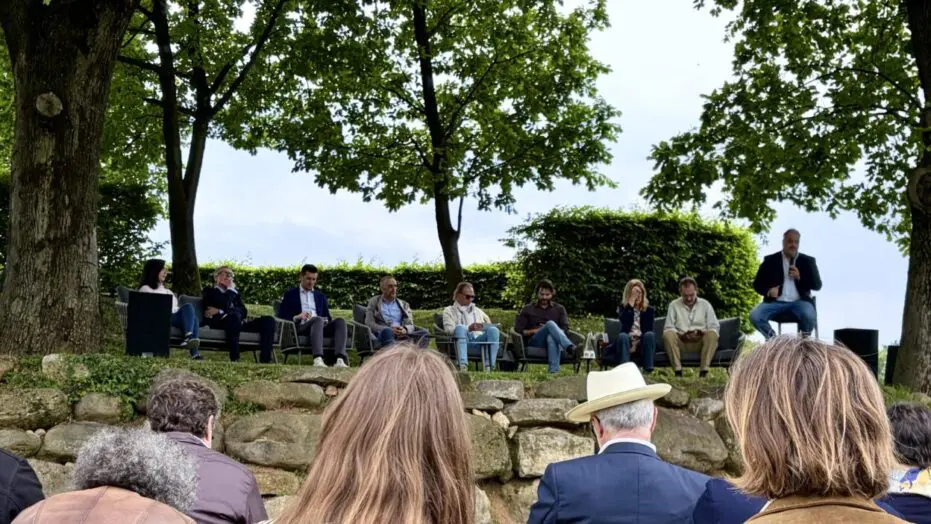
Agroforestry Conference Mosnel 2026
Georgio Vacchiano – researcher and science communicator at the University of Milan
For a long time, the modern vineyard sought order, uniformity, and control. It became a monoculture in pursuit of efficiency. Trees all but vanished from the scene, as if their presence introduced nothing but disorder. Today, amidst warmer seasons, more vulnerable soils, and increasingly uncertain water availability, that separation reveals an ecological cost that weighs ever more heavily on the stability of the viticultural system. Integrating vines and trees reopens a possibility. That of actively influencing vineyard function by improving its microclimate, soil health, nutrient cycles, and water dynamics.
The climate is amplifying extreme conditions. Vitiforestry offers a practical way to bolster resilience and production continuity. That applies only if every decision remains firmly anchored to the specific site and is accompanied by ongoing monitoring, adjustments and adaptation. From this perspective, there is an opportunity to design ecologically structured vineyards that are capable of harmonising production, quality, living soil, and biodiversity. This technical approach is measurable and replicable.
Willem Brouwer – architect
The pandemic allowed me to observe new, emerging needs and expectations. Nature now appears to many as a haven. Particularly among younger generations, there’s a focus on health, mental well-being, sustainability, and the quality of spaces. Psychological, social, and environmental comfort has assumed a more significant role, not just purely economic factors. I had the opportunity to delve into how these new contexts affect architectural and landscape design. People carry with them the projects they have seen and the emotions they have experienced.
Andrea Bariselli – psychologist, neuroscientist and science communicator
The human brain is not neutral with respect to the landscape. Decades of neuroscience research demonstrate that the environments in which we live and work are not passive backdrops. Rather, they shape our attention, stress levels, cognitive abilities, and even the quality of our sleep. When we walk among the rows of a vineyard at dawn, or observe the silhouette of a hillside as it changes with the seasons, we are not merely enjoying a beautiful spectacle. We are activating ancient neural circuits, forged over millennia of co-evolution between our species and nature.
A “restorative environment” is not just an aesthetic concept, but also a physiological one. Spaces with high visual complexity, perceived biodiversity, and the presence of variable and unpredictable natural elements produce measurable effects on the autonomic nervous system. They lower cortisol levels, reduce rumination, and enhance attention.
A vineyard that integrates agroforestry, hedgerows, and border biodiversity is not merely a more resilient, productive ecosystem. It is a landscape that fosters cognitive and emotional well-being in those who inhabit, traverse, or work within it. This enhances a sense of belonging to the land, the quality of life of those who work there, and our capacity to perceive a connection to something greater. This is profoundly beneficial for all of us.
And Finally
Mosnel Lucia and Giulio
My understanding now is that Agroforestry at Mosnel is a specific interpretation of what we may call Regenerative Agriculture. It’s multidisciplinary in approach and linked to the specifics of place. This is a way to enhance the environment, landscape, wine production and cultural heritage for the benefit of nature and people. Throughout history, vineyards were often named after trees, even though those trees are often long gone.
In short, it’s a Manifesto of sorts, where balancing many different needs is the key to success. It gives us hope for a future long after we’re gone. Both thought-provoking and inspirational, much of what was said at the conference resonates personally. It informs the stance long taken by this website on sustainability.
Meanwhile, a vertical tasting of their magnificent EBB and the Parosé wines will be the subject of a future article. Suffice to say here that the beautiful scent of Jasmine in the Mosnel courtyard is still there!
Meanwhile, please join me in a toast to Mosnel and the success of its Agroforestry project.
**Lifting glass of Mosnel Franciacorta Sàten**
Cin-Cin!
Location
Mosnel
Via Barboglio, 14
25050 Camignone di Passirano (BS)
Lombardia
Italy
What3words Location
Notes
- That article covers the history of the estate, including the foundation in 1836 and its contribution to the development of Franciacorta DOCG as we know it today. At the 180, there was a special vertical tasting of the Mosnel EBB Cuvée and a memorable trip to nearby Lake Iseo to attend the Christo and Jean-Claude exhibition, The Floating Piers. In the years since, Mosnel were early adopters of the obscure Erbamat grape as a measure against climate change.
- Fibonacci starts with a simple number sequence, but can then become complicated! It has led to applications in art, architecture, music and computer science. Many art lovers will be familiar with Fibonacci, as it forms the basis of the Golden Ratio. This geometry is frequently repeated in the natural world of which we are a part. The shells of snails, the branching of trees and the spiral arms of Galaxies are just some examples.
With thanks to Lucia and Giulio Barzanò, and all the speakers. I hope I’ve done them justice.