
Carminium by Inama – The French Connection
Carminium is a dry red wine from the famous Inama estate, and is 100% Carmenère.1 That’s a rare cuvée in Italy, as we shall see. In 2017, while visiting the Colli Berici DOC, I spent a memorable August afternoon at Inama’s Oratorio vineyard, though at that time, Carminium was still in the future.
Inama’s roots lie in the production of Cru Soave and Sauvignon Blanc, with their headquarters at San Bonifacio. In the 1990’s, like many of their Soave contemporaries, they ventured into making red wines from other parts of the Veneto. Most of these wineries went west with the well-known and established Valpolicella and Amarone. But Inama do things differently.
Inama chose to head in the opposite direction, 15 Km eastwards to the relatively unknown Colli Berici DOC near Vicenza, where Bordeaux varieties have grown for centuries. Their entry point was the purchase of the Villa del Ferro vineyards in San Germano dei Berici, already renowned for Merlot.
The Colli Berici
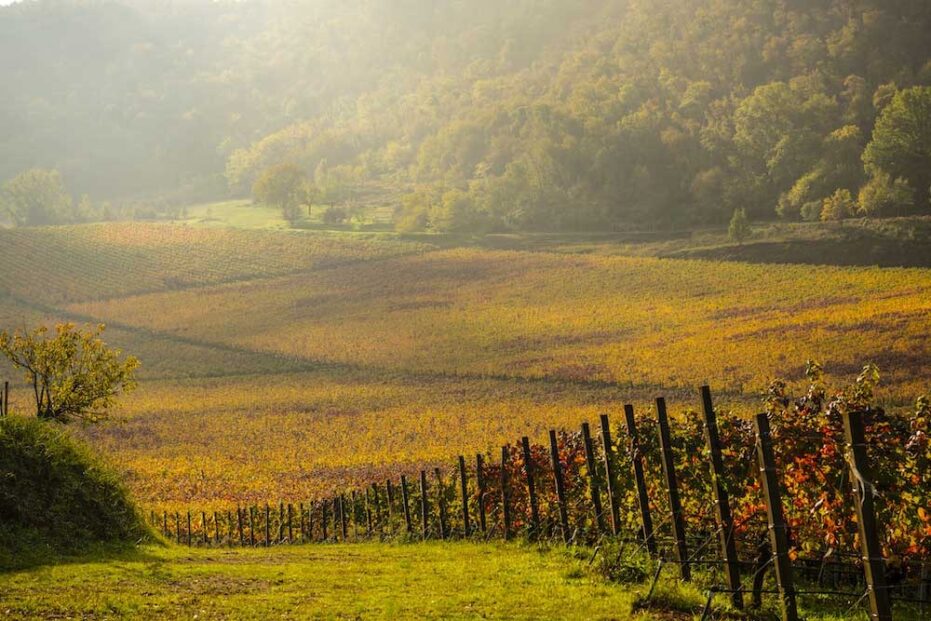
Oratorio vineyard, autumn
The Colli Berici terroir, with a long, dry growing season, is particularly auspicious for the well-known Bordeaux varieties such as Merlot, Cabernet Franc and Cabernet Sauvignon, which have been here since the early 1800s.
Indeed, the late Italian wine writer, Gino Veronelli, said that this area was one of the best in Italy for these grape varieties.
Moreover, the Colli Berici DOC is the oldest DOC for Cabernet Sauvignon and Merlot and was the first DOC in Italy to authorise Cabernet Franc. This DOC also has a genuine rarity, a variety called Tai Rosso (a biotype of Grenache), which you can read more about in this previous Wine Alchemy Colli Berici DOC article.
Inama didn’t pursue Tai Rosso, but has had considerable success with their Bradisismo (a blend of Cabernet Franc, Cabernet Sauvignon and Carmenère, first released in 1997) and Campo del Lago, a 100% Merlot.
In a new project, they planted Carmenère in 2002 at Oratorio di San Lorenzo, near San Germano, in a new single vineyard of 12 hectares. In so doing, this became (and still is) the largest single planting of Carmenère in Europe! That decision showed Inama’s belief in this variety’s potential after conducting extensive research.
Time then for a brief word about Carmenère and how it got here.
Carmenère
Carmenère has an unusual backstory. Firstly, it’s an ancient grape first mentioned in documents from its homeland in Bordeaux, France, in 1784. DNA profiling shows that Cabernet Franc is one of its parents, just like it is for Merlot and Cabernet Sauvignon. And while each variety has different characteristics and needs, they all look very similar and can be easily confused.
Once widely cultivated in the Médoc, Carmenère was almost wiped out by Phylloxera in the 1870s. It never recovered in France, and now only a few remnants remain. It wasn’t replanted because other varieties had predictably higher yields. Ironically, these replacements were often the Cabernets and Merlot!
But before Phylloxera struck, cuttings had been taken that found their way abroad, for example, to Italy, Chile and California. However, those plants were thought to be Cabernet Franc in Italy, and Merlot in Chile and California. This confusion occurred because identification still relied on Ampelography. This case of mistaken identity then continued until relatively recently, up until the establishment of DNA profiling.
It’s not Cabernet Franc. Or Merlot.
In Italy, Carmenère was introduced as Cabernet Franc, growing in Piemonte in 1820. Carmenère was in the Colli Berici by 1830, bought there by Italian workers returning from Bordeaux, alongside Cabernet Sauvignon. Merlot arrived a little later. By the 1850’s, Carmenère was planted in California and Chile, although in those cases it was believed to be Merlot.
The establishment of DNA testing in 1994 began to show that a considerable amount of Merlot in Chile and California was actually Carmenère. One consequence was that Chile became the recognised power base for Carmenère. Similarly, in Italy, a good deal of what was believed to be Cabernet Franc turned out to be Carmenère and had to be reclassified. The relevant DOC rules were then subsequently amended.2
Perhaps the most curious part of this tale is that Carmenère does taste distinctly different from Cabernet Franc, Cabernet Sauvignon and Merlot! But given that single-variety Carmenère wines were the exception rather than the rule, that perhaps helped the misidentification persist, particularly when very similar-looking vines are planted in new and different climates. 100% varietal Carmenère wines in Italy remain few in number, but of exceptional excellence.3
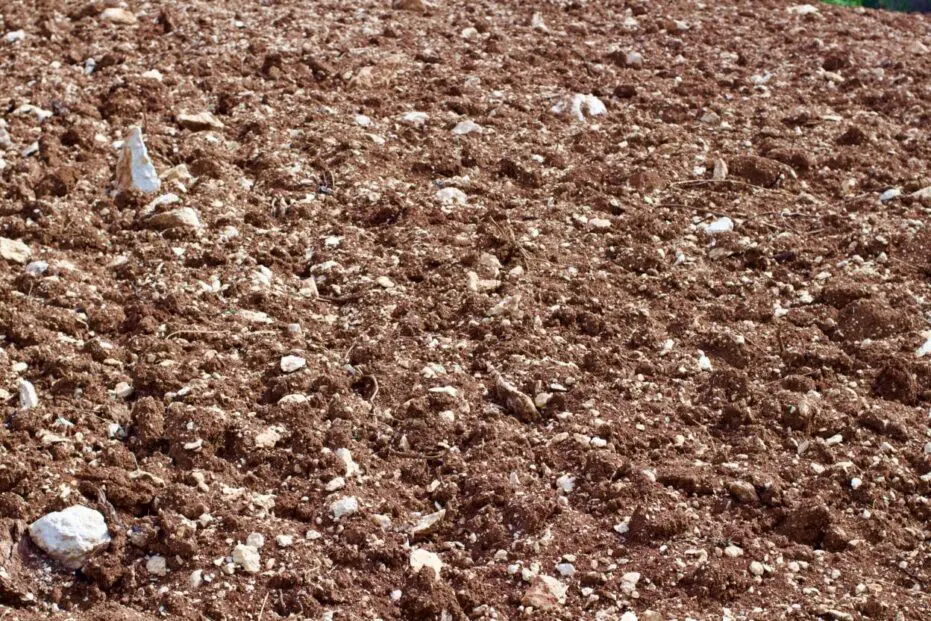
Terra Rosa Soil
Inama
Today, Inama are rightly one of Soave’s greatest names. Giuseppe Inama bought land at Foscarino (now a famous Cru Soave) in 1964, when the reputation of Soave was not what it is today! In 1991, he added Sauvignon Blanc, a highly successful move, albeit not without controversy. In 1992, his son Stefano took charge, and today the Inama family involvement now includes the next generation.
Since the addition of Bordeaux-based red wines, they have used Derononcourt Consulting’s additional expertise. Their farming has been organic since 2009, though uncertified. Now they have taken a step further into pioneering Regenerative Viticulture,4 certified by Diversity Ark.
Oratorio di San Lorenzo vineyard
The Oratorio di San Lorenzo vineyard takes its name from a nearby Benedictine monastery on the hill above a shallow valley. Those 12 hectares of Carmenère are subdivided into micro-parcels. The vines are from cuttings taken from their existing old-vine Carmenère vineyards in the Colli Berici, and are Guyot-trained, at a density of 5,000 plants per hectare. Each parcel is monitored for soil analysis and vine behaviour, and naturally, some perform differently from others. Harvesting is by hand, often in multiple passes, because perfect ripeness is the key to great Carmenère. Unripe Carmenère is immediately obvious – the grapes’ high concentration of methyoxypyrazine then shows a green vegetal character in the wine. That’s welcome in white Sauvignon Blanc, but to be avoided in red wine!
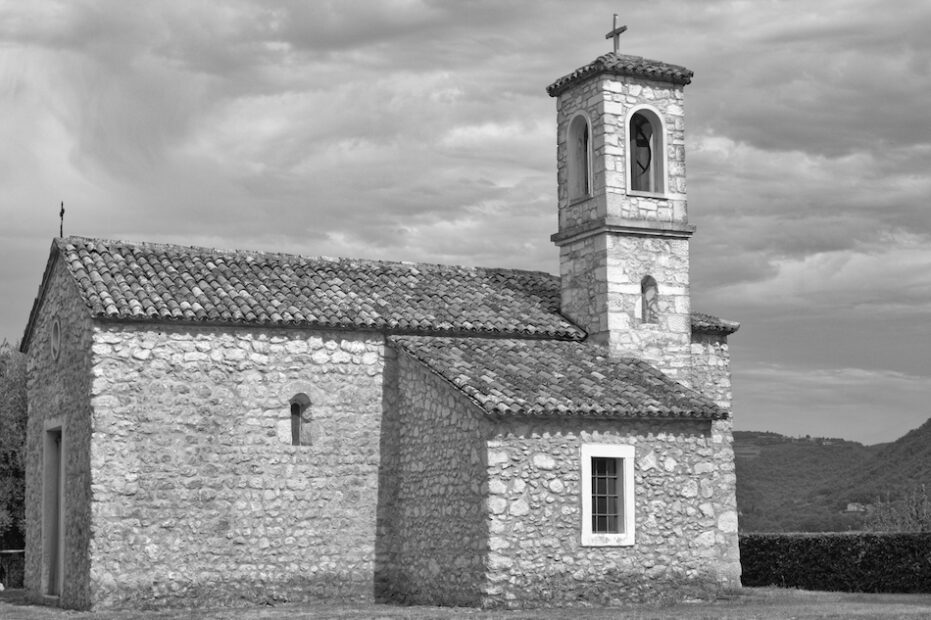
The Oratorio di San Lorenzo
The vineyard is surrounded by the protective forest of the surrounding hills and lies at a height of 50 -120 metres. A south and south-east exposure gathers strong sunlight from morning to evening. Such a situation means hot days in summer, but these are accompanied by fresh, cooler nights, thus offering the long, slow ripening that Carmenère prefers.
This part of the Colli Berici has soils known as Terra Rosa, a red calcareous clay which overlays limestone that was slowly uplifted over aeons by Bradyseism 5. That soil is full of minerals and trace elements, while also offering excellent drainage. In this dry area, a viticultural challenge will be water stress, but mature vine roots go deep.
Inama makes three wines from this vineyard
When the vines were younger, most of the grapes were used in a mostly Carmenère blend called, literally, Carmenère Più. But in the very best years, the very best grapes are selected to make a 100% Riserva called Oratorio di San Lorenzo, with a first vintage in 2009. This wine remains the flagship, a true “vino di meditazione.” It’s given 18 months in new French barriques and was a Wine Alchemy recommendation back in 2017.
Enter Carminium
By 2017, the vines were 15 years old and so of sufficient maturity and complexity. Hence, it was time to make a second selection of grapes to create Carminium. While this might technically be a second wine, it is in no way inferior in quality or enjoyment to the Oratorio Riserva. Instead, it’s a wine that can be enjoyed at a younger age while still retaining complexity and the ability to age for decades – that is no mean trick.
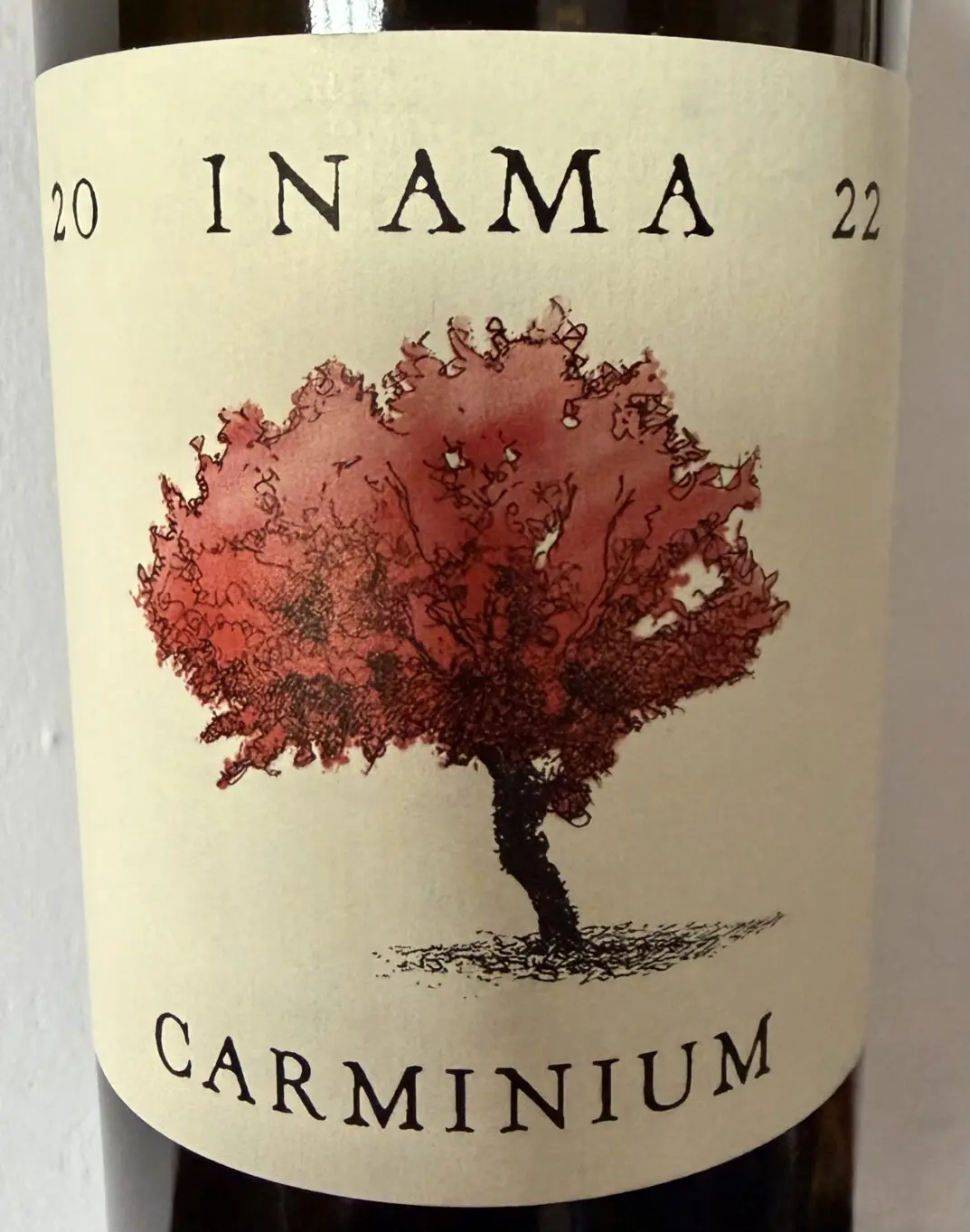
Until 2025, a single Mulberry tree stood alone in the heart of the vineyard. In autumn, the Mulberry leaves turn crimson, reprising the colour change in the vines, a symbol of this place. Sadly, that tree was lost in a storm last year, but it lives on thanks to the lovely Carminium label.
Now it’s time to find out what the wine is like in the glass.
Carminium, Carmenère, Colli Berici DOC, Italy, 2022. 14%
Technical
2022 is the current release. 100% Carmenère, a hand-harvested selection from the best micro-plots. Further selection at the winery after destemming, using a sorting table. Maceration for 24-48 hours only – no big extraction. Fermentation then begins and lasts 23-28 days at 28℃. 12 months ageing follows in French oak barriques (35% new and 65% used). After blending, the wine rests in stainless steel for four months. There is no fining or filtration, with bottling under a DIAM 30 cork. Then another twelve months’ maturation in the bottle follows. The cork guarantee is for 30 years – and so is a big clue to the expected longevity of this wine!
Tasting
Decanting Carminium for an hour before serving isn’t essential but is worth the time. This was primarily to help it open up, but it had thrown a slight fine sediment, so expect more sediment as it ages. In the glass, it’s a deep ruby colour, with a narrow purple rim indicating youth. Inama aims to offer elegance and balance, and achieves this admirably. There are strong aromas, primarily from the grape, such as Parma violets, with cherry and red berry. There’s an attractive balsamic note underpinning those, and maybe a fleeting hint of pencil-lead. It’s worth just stopping here to enjoy this moment in full, swirling and savouring.
Then, the palate is magnificently lithe and agile. Full-bodied and voluminous, yet perfectly poised, with an immaculate balance of fresh acidity and depth of primarily blackberry fruit. The tannins are resolved and melded in, with nothing harsh or edgy or needing more time. They help to provide a silken texture. The wood treatment is beautifully restrained, in a supporting role, adding some notes of clove and cocoa. This enables the terroir and varietal character to speak clearly and characterfully. The finish is satisfyingly long and persistent, offering moreish salinity before a final touch of white pepper. It’s worth restating that there’s no sign of herbaceous, vegetal or green pepper notes that would mar these aromas and flavours. There’s already complexity here, and doubtless this will develop much further over its expected lifespan. But this wine is already drinking brilliantly.
Food
Carminium is a gastronomic wine. Pair it with the classic British Sunday Lunch with all the trimmings. Porchetta would make an excellent Italian alternative, as would a board of salumi and cheese. Roast or grilled vegetables, especially aubergine, make an ideal vegetarian alternative.
UK availability
Wine Traders £34.12
For a complete Inama Carmenère experience, Wine Traders also have Carmenère Più 2022 at £23.54, and Oratorio di San Lorenzo Riserva 2017 at £77.45.
And Finally
Carminium is not just one of the finest wines of the appellation, it’s one of the world’s greatest single-variety Carmenères! So I bought a case of six. Let’s see how long I can resist opening one, as the intention is to see how these age.
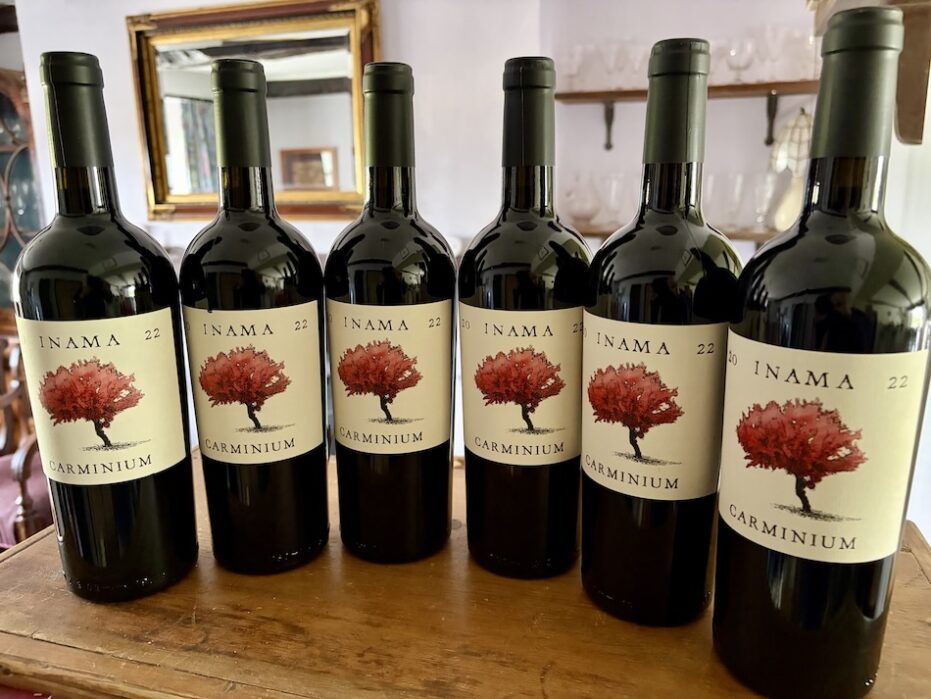
The Carminium Six
Location
Azienda Agricola Inama
Località Biacche, 50
37047 San Bonifacio (Verona)
Veneto
Italy
What3words Location
Notes
- I’ve seen the name of this grape variety spelt three ways: Carmenère, Carmenere, and Carménère. I’ve adopted the first one as the convention for this website.
- Italy had only 45 hectares of Carmenère reported in 2000. This had grown to 1,074 ha by 2010 (source, Kym Anderson). Most of this increase isn’t down to new plantings, but rather the correction of widespread misidentifications, usually as Cabernet Franc, sometimes as Merlot. This change accelerated following its addition to the Italian register of authorised grape varieties in 2007. It was subsequently incorporated by several DOCs, the first being Colli Berici DOC, in 2009.
- Besides Inama, I know of Colli Berici examples from Cantina Mattielo and PuntoZero. Another is by San Leonardo in Trentino.
- This is not the place to discuss Regenerative Viticulture in detail. However, at Inama, it includes: no herbicides or chemicals since 2009, Simonit & Sirch pruning, ultra-light tractors to prevent soil compaction, safeguard microbiological activity, and promote the growth of fungal mycorrhizae. Natural ground cover between vine rows protects the soil from erosion, preserves its structure, and enhances fertility. Biodiversity fosters beneficial insects, providing natural vineyard protection.
- Bradyseism describes a geological phenomenon whereby rocks are slowly pushed up by underlying volcanic magma or gas. The rocks can also descend if that magma or gas is released. This activity may cause faulting and seismic activity.