
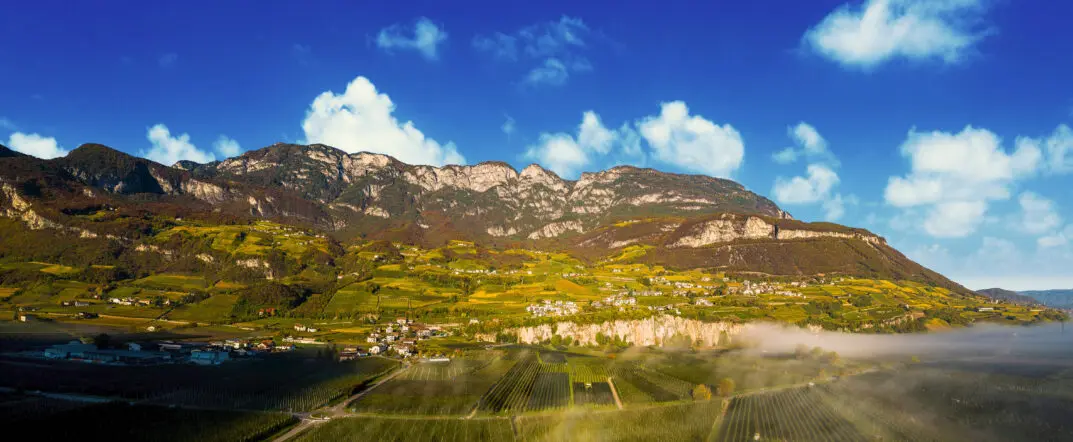
UGA at Kellerei Kurtatsch – and why these matter
Kellerei Kurtatsch has previously featured on these pages, albeit briefly. That was in a feature about Ushas, their wonderful sweet wine made from Rosenmuskateller. This time, the coverage goes deeper, focusing on the new Kellerei Kurtatsch UGAs, explaining why these matter and how to recognise them. Then we’ll meet five of their nine wines which now have UGA status.
But before we get to the that it’s worth taking some time to revisit Kellerei Kurtatsch.
Kellerei Kurtatsch and its terroirs
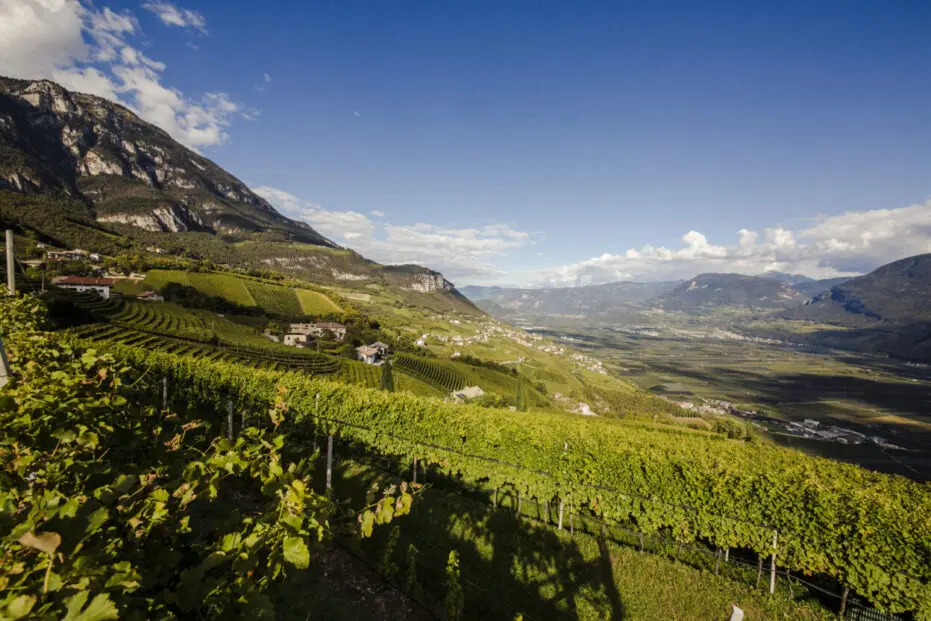
Kurtatsch looking north ©Florian Andergassen
Kurtatsch (known in Italian as Cortaccia) is a village of 2,200 souls in the southernmost Alto Adige (Südtirol) region. It has some Italy’s most striking vineyard sites and so is a key venue on the Alto Adige Wine road. Meanwhile, Kellerei Kurtatsch is the most southerly cooperative wine producer in the Alto Adige region.
This cooperative, established in 1900, is also one of the oldest and smallest. There are 190 members, with 190 hectares. So even though the average family holding is one hectare, in aggregate there is a wide array of vineyards, with different soils, elevations and grape varieties. Many of those members are orchard fruit growers, with orchards in the valley bottom. Their tiny vineyards are on breathtakingly steep slopes from 220-900 metres in altitude, which is said to be the biggest single altitude span in Europe. Indeed, this factor enables many different grape varieties to thrive.
The lower elevations, which are below the village, are among the warmest in Alto Adige, where temperatures can regularly exceed 40℃ in summer. Their sand and clay soils are ideal for red varieties, including the Bordeaux classics. Meanwhile, the high-altitude sites are primarily on limestone gravel and sand, are cooler, so perfect for a range of whites.
There are also 300 days of sunshine per year and, influenced by both the Alps to the north and Lake Garda to the south, there’s a wide diurnal temperature variation, with cool katabatic winds and yet an important Mediterranean influence too.
Such a wide range of microsites naturally enable the winery to focus on premium terroir wines, which has been their focus since the early 1990s.
Embracing sustainability
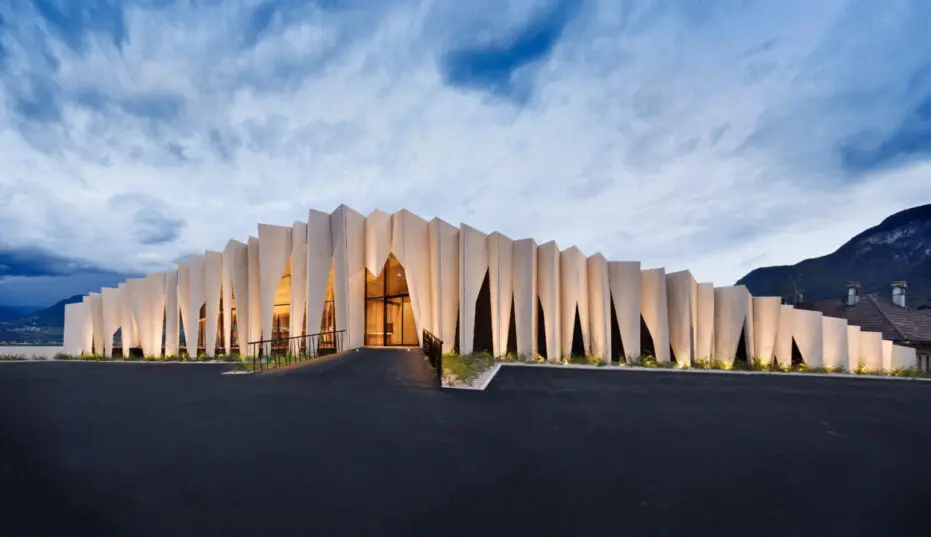
Kellerei Kurtatsch Winery ©Oskar daRiz
A young team, led by the winery’s president Andreas Kofler and winemaker Erwin Carli, has oriented the cooperative towards sustainable management initiatives in the vineyards and the winery. Indeed, they will become fully SQNPI certified in 2026.
Since 2020, the Kellerei presents a stunning post-modern architectural face to the world. Wine tourism and hospitality has been recognised here as a major contributor commercially. This dolomitic delight on the edge of town is partially underground and gravity-fed. State of the art equipment includes heat recovery, water recycling, and EV charging.
Meanwhile, the historic winery buildings in the centre of town had upgrading to strict KlimaHouse/CasaClima/Climate House standards of energy efficiency.
Sustainable packaging, including recycling and reducing bottle weights are also part of a package of carbon reduction initiatives. All bottles use natural FSC-certified cork closures and a transition is being undertaken to use DIAM corks.
“Our task is to understand where each grape variety can express itself at its best, particularly as growing conditions evolve in response to climate change, and to translate that relationship into wines that convey their origins with clarity.”
Annual production is about 1.6 million bottles, with 30 different wines made. 65% is white and 35% red, the same ratio as applies to the region overall. Presently, only 30% finds its way abroad, particularly to Germany, Austria and Sweden. Fortunately, some of these top wines, including all those featured here, are available in the UK!
Time then, to look at UGAs and what they are designed to achieve.
UGA
The acronym UGA in Italian stands for Unità Geografiche Aggiuntive, quite the mouthful! Ironically, the German word for this is the (mercifully short) Lagen. Whatever the language, it translates as Additional Geographical Unit.
Various versions of these have been gradually introduced by some Italian wine regions over the last decade or so, and they only apply to DOC and DOCG, never to IGP. Gradually, famous Italian wine areas such as Barolo, Barbaresco, Soave and Chianti Classico Gran Selezione have introduced UGAs, though each place has taken its own approach to how their UGAs are defined.
You’ll also find them elsewhere in Italy as well, for example in Prosecco Conegliano-Valdobbiadene DOCG, (which call them Rive), Etna DOC (which call them Contrade), and Vino Nobile di Montepulciano DOCG, which call them Pievi. Doubtless more will appear in future. Wines that meet the specific UGA definitions, which are formulated by each DOC/DOCG, can now show their place names on the label. In turn, that provides a closer tie to the land that birthed the wine. Just don’t expect a UGA in one wine region to resemble that in another – it’s the local interpretation of UGA defined by its DOC/DOCG that’s important.
UGA application in the Alto Adige DOC
The Alto Adige, (Südtirol), is a region where remarkably, 96% of all wine production is classified as DOC wine, although there are no DOCGs. In this mountainous area, vineyards tend to be small and fragmented. Within the DOC there are already seven subzones1. However, these subzones are too large to interpret the vast range of different terroirs they contain. Furthermore, each of these subzones has a large number of grape varieties, many of which are grown throughout the region. Consequently, until now there has been little official recognition where specific grape varieties match their best vineyard sites at a local scale. Hence, starting with the 2024 vintage, 86 named UGAs have been added, which are now at the top of the Alto Adige DOC quality pyramid. The existing subzones will also continue.2
The rules
Each UGA has been defined by consistent and detailed mapping based on scientific research and agronomic experience. The idea is to recognise the highest quality and communicate an explicit link to local terroir factors that are ultimately responsible. Naturally, there some new rules to ensure the UGA can represent the highest quality, but these are straightforward:
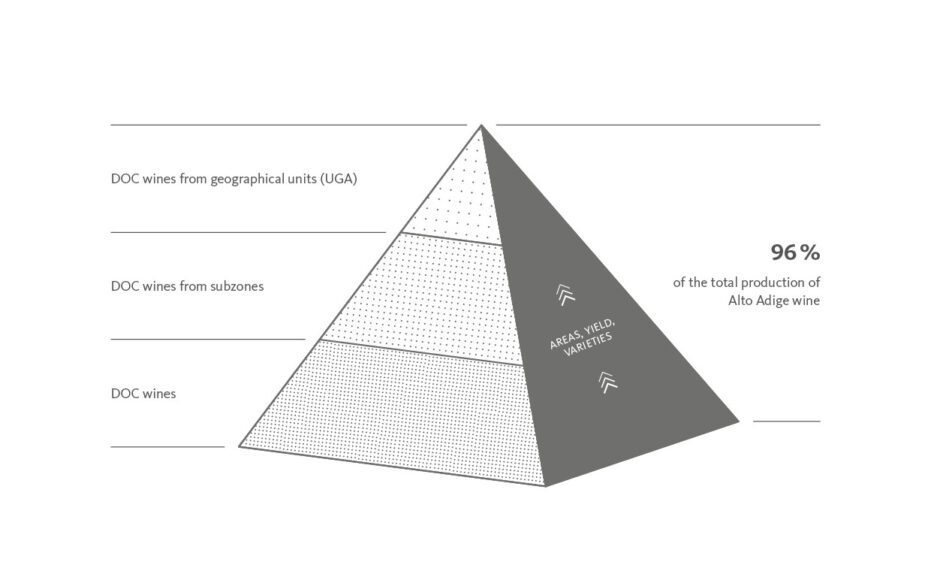
Alto Adige DOC quality pyramid with UGA/Lagen.
Each UGA has at least one grape variety associated with it, but five varieties is the maximum number permitted in any one UGA. Then, only grapes grown within the UGA boundaries can be used for the resulting wine. Those grapes also have lower permitted yields, up to 25% less in comparison to the DOC maxima. The individual UGA names may be unfamiliar to us, but most of them are historic and known locally.
The UGAs are not compulsory, and currently represent around 6% of total wine production. The expectation is that this will gradually increase to about 10% as the concept is embraced by more and more producers and the initiative becomes better recognised commercially. Being able to command a higher price for such wines should be a good incentive for adoption. So far, because the DOC production is dominated by high quality co-operatives such as Kurtatsch, early UGA adoption has been rapid.
Note though that there is no hierarchy within the UGAs – they all have the same equal status. Comparing one UGA with another is about differences in terroir, though you may of course have a preference for a wine from one UGA over another UGA. And, as most UGAs have multiple vineyard ownerships (from coops to private families and companies), there is still plenty of scope for different producers to create individual excellence and stylistic differences.
A New Symbol
UGA/Lagen symbol, Alto Adige DOC
86 new UGAs, each with an unfamiliar name, unavoidably introduces a new level of complexity that some may find daunting, at least initially. Fortunately, a new prominent symbol can easily represent the UGA category. This will eventually be shown on all relevant UGA/Lagen bottles from the Alto Adige DOC. This logo is again being gradually rolled out so expect to see more bottles showing this symbol over time. From a consumer viewpoint, the specific name might be initially unfamiliar but the logo will show that it’s a wine from the top level.
For wine lovers and producers, UGAs matter, because they offer greater transparency and greater confidence when it comes to a wine’s provenance and traceability. Kurtatsch have been able to embrace this new initiative because for them it doesn’t represent a fundamental change. Rather, it’s an official confirmation of their existing terror-driven philosophy that has been in place for many years.
So much for the theory. Let’s now see if all this translates in practice into the quality of the wines themselves!
The Kurtatsch UGA wines
Kurtatsch makes nine wines from eight UGAs, and these account for about 13% of total production. Not all are covered in this article, which features those five wines that are available in the UK at the present time. Rather than provide lengthy descriptions of each UGA, the 3D map below shows the sites in relation to one other and is largely self-explanatory.
On the left of the map, their Pinot Bianco (Penon-Hofstatt), Schiava (Sonntaler) and Merlot Riserva (Brenntal) wines are from the warmer west side of the Adige valley at Kurtatsch, where exposures are from east to south. Then, on the right of the map there are two Pinot Noir Riservas (Mazon and Glen). These two are the only areas outside Kurtatsch, being from the opposite, cooler east side, where exposure is west to south. We’ll now meet each wine, in the same order.
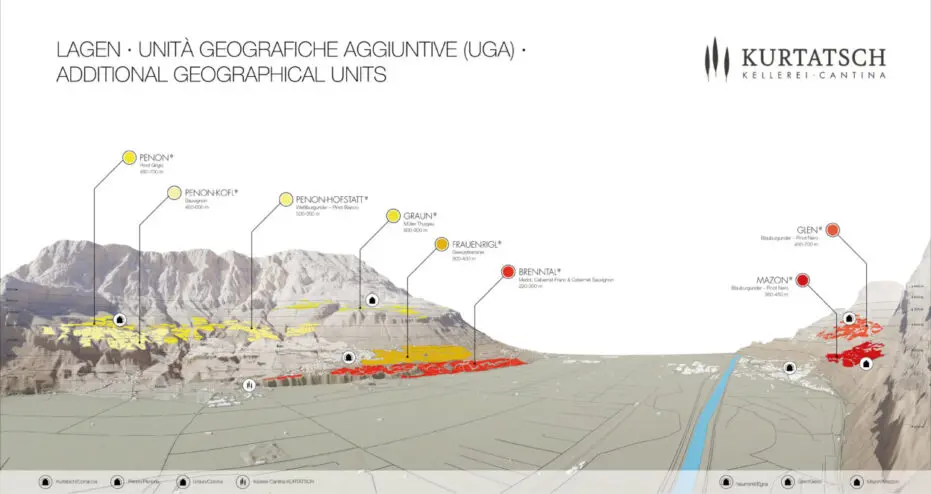
Kellerei Kurtatsch UGA/Lagen 3D Map
Pinot Bianco, Pennon-Hoffstatt, 2024. 14%
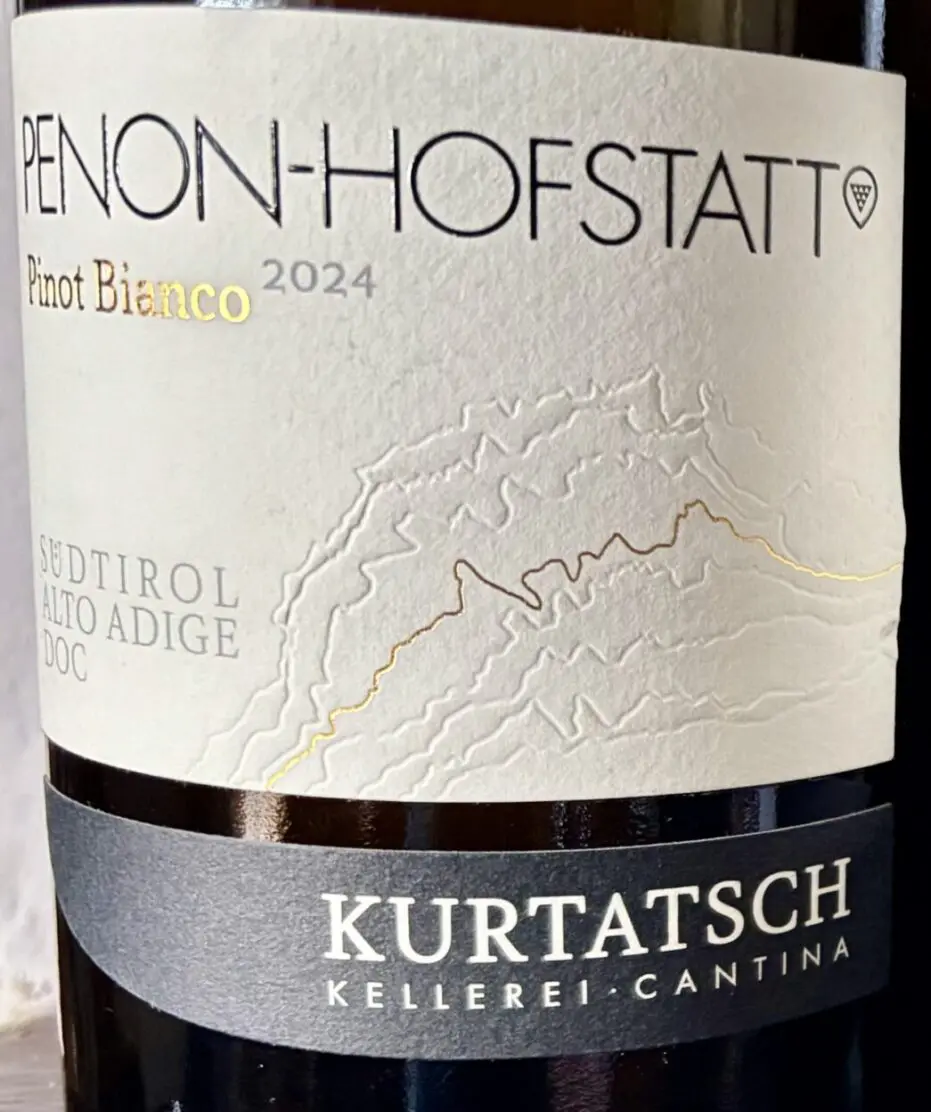
Penon-Hoffstatt UGA
Terroir and Technical
Penon-Hoffstat UGA covers 22 hectares above the village, and is solely for Pinot Bianco (Weissburgunder) at 500-650 metres facing SSE on mineral laden dolomitic limestone. Cool katabatic winds descending at night from mountain tops provide diurnal variation and breezes that helps retain acidity in the grapes. Low yield 55hl/ha. Fermentation in stainless steel, with ageing on the fine lees in large oak barrels for 9 months. There is a deliberate avoidance of oak influence and no malolactic fermentation. 2024 was a relatively cool vintage.
Tasting
Mid-bright yellow, delicate apple and pear and verbena aromas. On the palate, these are accompanied by floral and green herb notes. Great balance of alcohol and acidity, a smooth rounded texture thanks to that barrel ageing but with no hint of wood flavour to get in the way. Great depth and richness, while lively acidity keeps things fresh and very precise, before a long slow dry fade. Drinking perfectly now and say over the next 4-5 years. A superb and stylish example that’s up there with the best Pinot Bianco.
UK: Alpine Wines, £30.96
Schiava, Alte Reben, Sonntaler, 2025. 12.5%
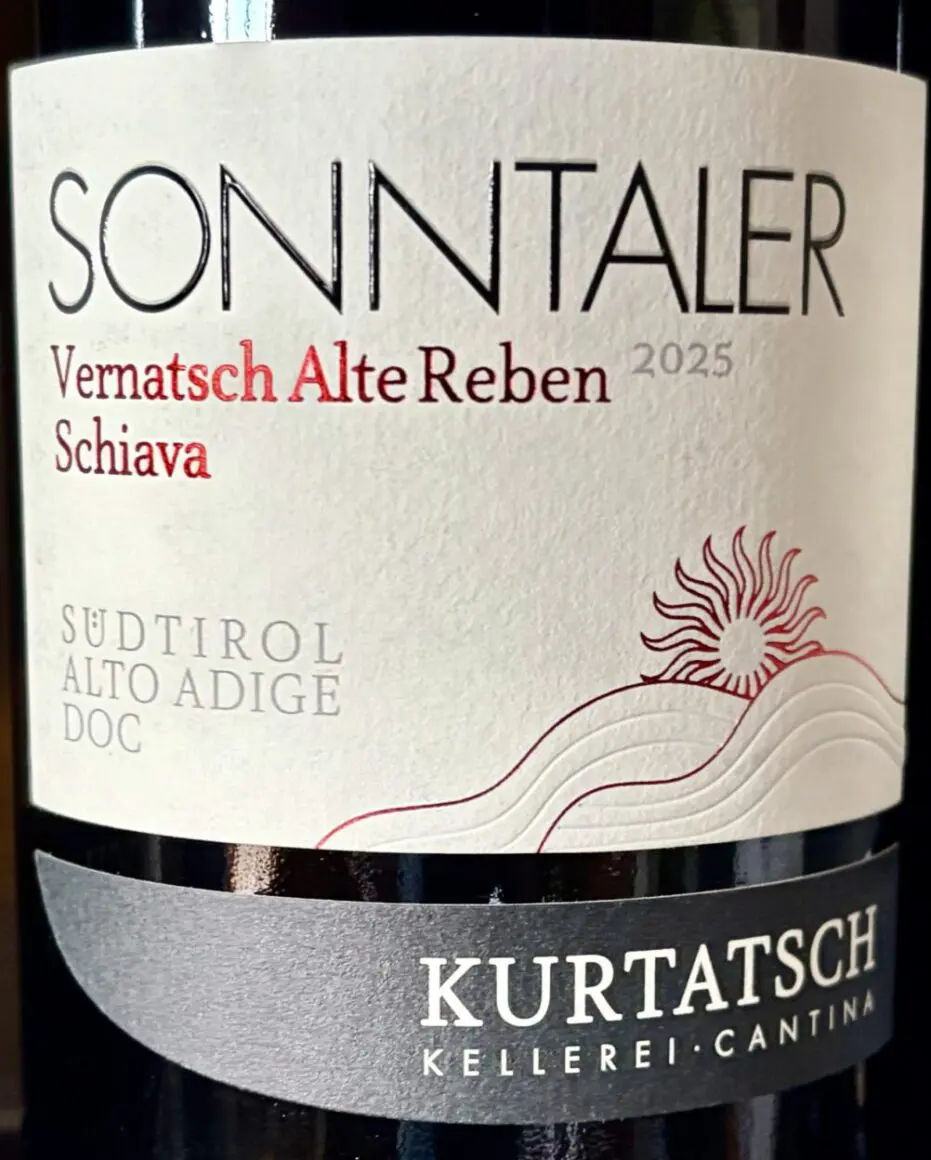
Sonntaler
Terroir and Technical
Schiava is also known as Vernatsch, while Alte Reben means old vines – here these are between 60 and 90 years old, with Pergola training. Sonntaler is an assemblage of the different Schiava varieties. Old vines mean naturally low yields of 75hl/h, extremely low for such a vigorous variety. Fermentation in stainless steel, with malolactic fermentation and ageing in concrete tanks for 6 months. Sonntaler is east-facing at 300-400 metres on red sandy soils. The 2025 vintage is considered to be one of the best ever for Schiava. My understanding is that this terroir-driven wine still includes 5% of grapes from outside UGA boundaries in this new vintage, so cannot use a UGA name at present. Will it change to a UGA in future?
Tasting
Don’t chill this one. Bright light crimson. Complex aromas of raspberry, cranberry, cherry and redcurrant. Palate characterised by elegance, lean and sleek. Fine-grained tannins bring a soft texture, a reprise of the red berry fruits and then pomegranate on a final long farewell. Really shows how elegant Schiava can be when grown in the right place. Drink now when at its freshest and over say 3-4 years. Fabulous wine and terrific value too.
This wine was the winner of the prestigious Vernatsch Cup in 2026. Sonntaler is also a regular award winner over the past 30 years. That does highlight a commercial dilemma that some producers may face in adopting UGAs. Do you keep a much loved and highly praised classic in its current form, or convert it to a currently less well known UGA? Tough call.
UK: Haynes, Hanson & Clark, £21.95
Merlot Riserva, Brenntal, 2022. 14.5%
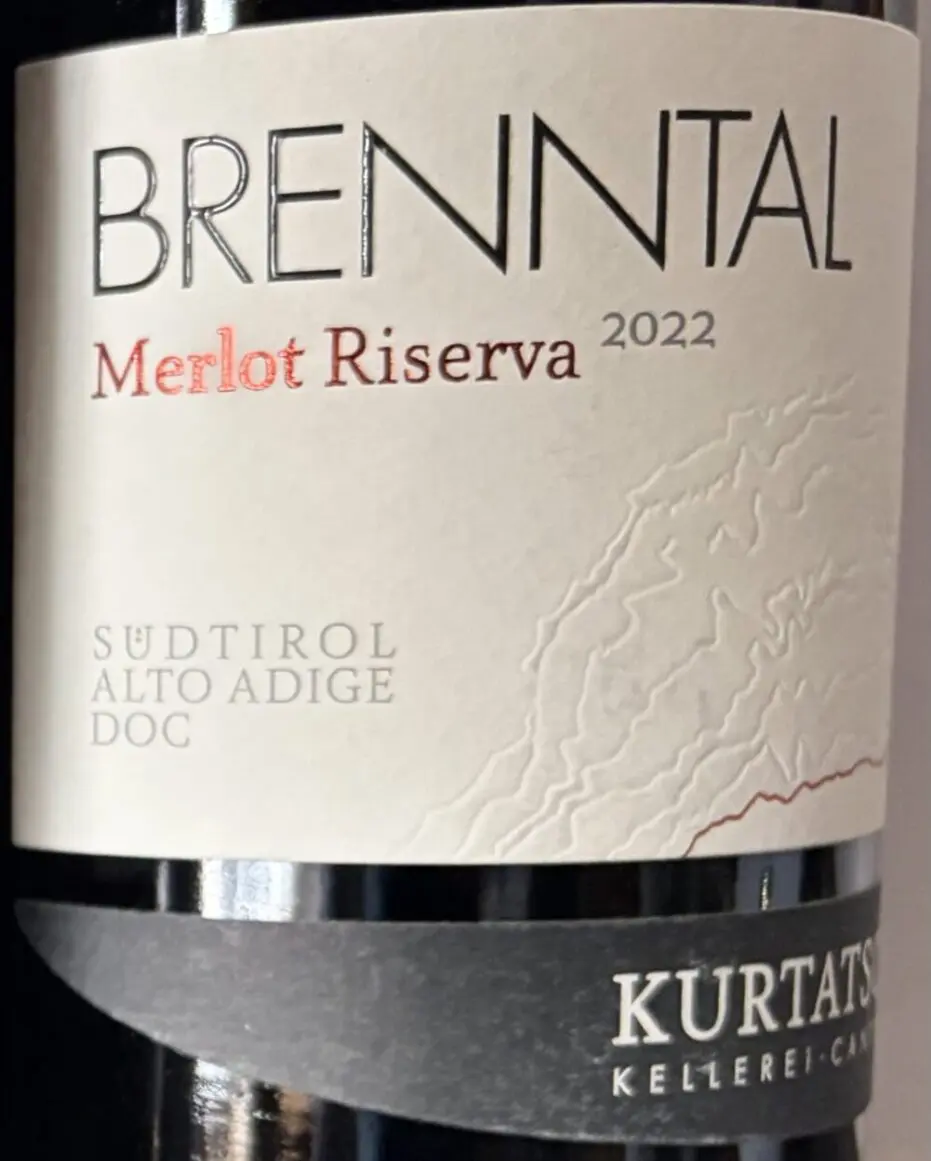
Brenntal UGA
Terroir and Technical
Brenntal is 29 hectares, at 214-307 metres, and the UGA also covers Gewürztraminer and Cabernet Sauvignon. Strong sunlight intensity on steep SE facing slopesAs an aside, Brenntal means “burning valley” and now climate change is making Brenntal ever warmer, so Kurtatsch will use a different UGA for their top Gewürztraminer in 2026, and use Brenntal UGA solely for this Merlot Riserva.
Red sands and loam soils, with clay and iron. Yields of only 40hl/ha. No canopy management on the outside of the vine so the leaves protect the grapes from sunburn. Fermentation is in rotary tanks for tannin management. Ageing is then for three years; first 12 months in used oak barriques, then 12 months in old large barrels, and a finally a year in bottle. This maturation regime ensures that the wood supports gentle maturation and lets the terroir influences show rather being masked by wood flavours. First made in 1995.
Tasting
Decanted for an hour prior to serving, as this is a powerful young wine with decades of potential development ahead. Drinking now and over another 15-20 years?
Deep, dark, purplish, dense. A big wine , but elegant thanks to a lively acid spine and resolved velvet tannins. Polished yes, but not overdone. Aromas and flavours of blackberry and loganberry fruits rather than being plummy. Something alpine in here too, not herbaceous or green, perhaps gentian (?), yet without bitterness. Very long and persistent to a satisfying dry finish. No overt wood to get in the way either.
In short, this Merlot is colossally good, a brilliant expression of terroir with all the complexity and nuance of the best Bordeaux wines but with a lithe and elegant alpine twist. This really is world-class Merlot and rightfully a flagship of the winery.
UK: Alpine Wines £64.80
Pinot Noir Riserva, Mazon, 2022. 14%
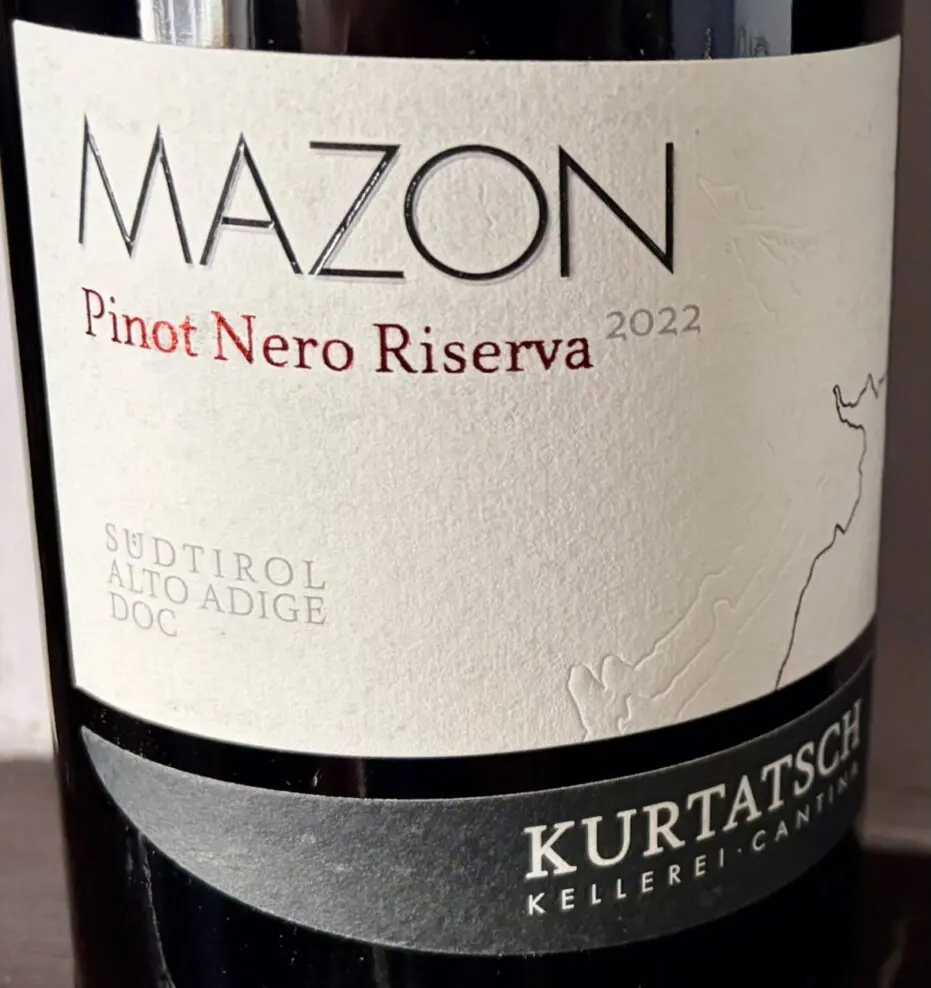
Mazon UGA
Terroir and Technical
Mazon is already one of the most famous sites for Pinot Noir in Italy and is solely for Pinot Noir. It occupies 66 hectares, with Kurtatsch vines occupying 1.8 ha at 350-450 metres, which is relatively low down. and it faces Northwest, so lower heat and less direct sunlight. Sands and dolomite. Low Yields of 40 hl/ha. 2022 was a very warm year. Cold maceration then spontaneous fermentation with indigenous yeasts in stainless steel tanks. Ageing for 12 months in barriques and at then least another year in bottle.
Tasting
Decanted for 90 minutes because Mazon is known to take time to open and develop and is best with bottle age. Slightly darker and denser than Glen (below). Initially a subdued nose, in fact this wine was more open the next day (!). Then it showed ripe black cherry, earth, sous-bois, and violets. These aromas reprise on the palate with a citrus zest note. Elegance in acidity and a final spiciness and mineral sensation on a long length. Much more yet to come in the medium term, keep at least another couple of years, then drinking for say a decade after that.
UK: Xtrawine, £31.00
Pinot Noir Riserva, Glen, 2022. 13.5%
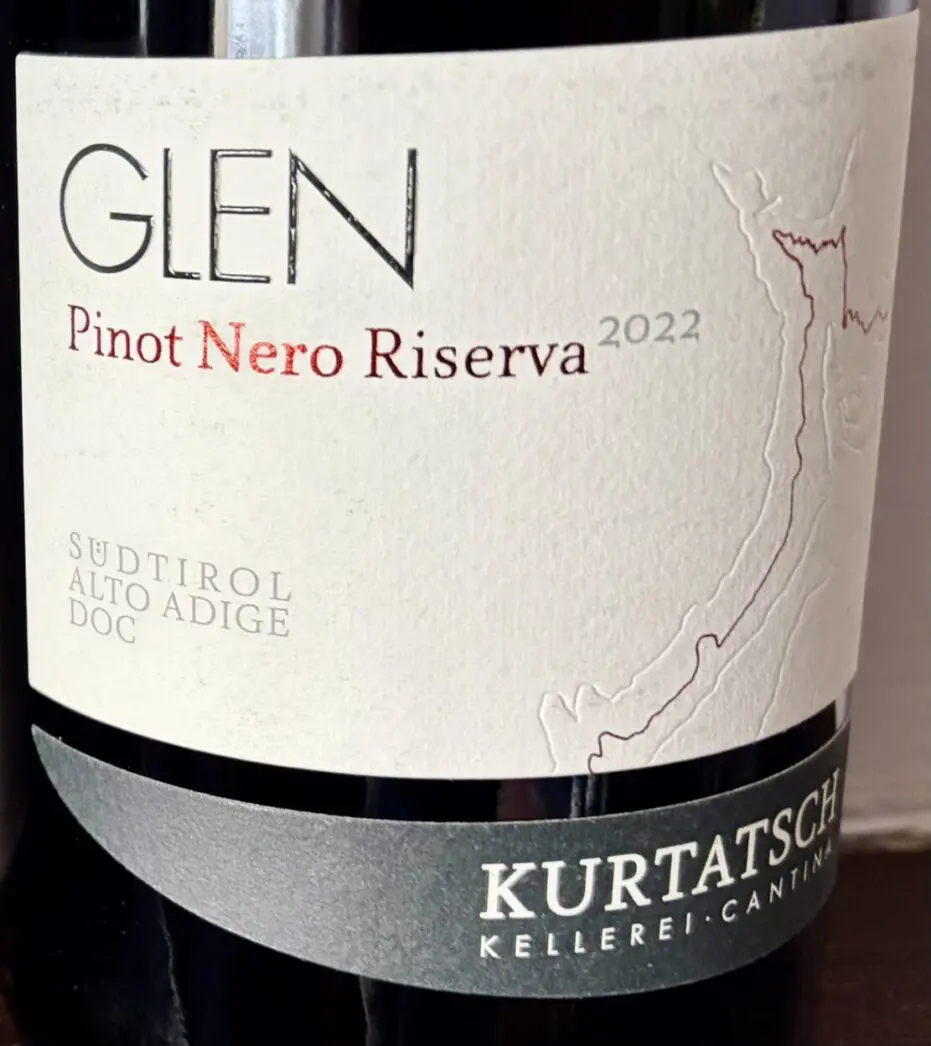
Glen UGA
Terroir and Technical
Glen is another highly regarded Pinot Noir site, again a UGA solely for Pinot Noir. However, a much higher altitude than Mazon, with Kurtatsch vines at 450-700 metres facing a different aspect, being SW. Again, receives the afternoon sun and more limited direct sunshine hours, but more exposure than Mazon with higher diurnal temperature swings. Yield of 50 hl/ha, still low. A mixed set of Pinot Noir clones, with local, French and German examples in the vineyard, average age 17 years. 2022 again a warm year here. Fermentation in old wooden vats, 20% of grapes are whole bunch fermented. 5% matures in old barrels, the rest in barriques of different ages for 12 months.
Tasting
Decanted for 90 minutes. Fully opens up in the glass after about ten minutes. A shade lighter colour and less dense in appearance than Mazon. More expressive at this stage, fruit in the raspberry and red cherry spectrum. The darkness of Mazon replaced with a more immediate and elegant expression thanks to more pronounced acidity. Spice notes more pronounced on aroma and palate too. Long violet-tinged finish. Ready to drink now if you decant it. Drink in preference to Mazon in the short-term, probably the reverse over longer timescales. Suspect won’t have the longevity of Mazon but an excellent Alpine expression nonetheless.
UK: Alpine Wines, £41.66
And Finally
In the Alto Adige DOC, each UGA seeks to match at least one grape variety with its best terroir. UGAs are the future direction of the DOC, and, despite adding complexity, it’s an excellent initiative that should pay dividends once fully established. With UGAs, Alto Adige DOC have added even more quality potential in a region that already has a great reputation for wine excellence.
Meanwhile, wine lovers as well as producers should embrace these new UGAs – wines from the Alto Adige deserve a wider recognition in the UK. So, in future, just look for their UGA symbol!
Article Update v2.0 September 2026.
Now contains new information about the Kellerei’s latest annual financial results. Specifically, the Cantina has announced record turnover in the past financial year, up 11% to €12.34 million. They regard this result not as an isolated achievement, but as confirmation of their long-term vision.“ For a cooperative such as ours, growth is not simply about increasing numbers. It means strengthening our vision: recognising the value of our member families’ work, communicating our identity more clearly, building strong relationships across our different channels and helping people better understand the connection between wine, grape variety, altitude and vineyard landscape.” In a currently gloomy wine world, the Cantina is showing us that strong financial performance remains achievable if you develop and maintain a relentless pursuit of excellence at all levels. Long may that be the case.
Location
Kellerei Kurtatsch / Cantina Cortaccia
Via del Vino, 23
39040 Cortaccia SSDV (BZ)
Alto Adige / Südtirol
Italy
What3words Location
Notes
- The 7 existing subzones in alphabetical order are Bozner Leiten, Eisacktaler, Kalterersee, Meraner, Sankt Magdalene, Terlaner and Vinschgau. I’ve used the German rather than Italian names as they often appear on labels in that form.
- If you would like to know the names of all 86 UGAs, their locations, and which grape varieties link to them, then here’s a handy map.
Thanks, of course, to Kellerei Kurtatsch for sharing the wines, and to the Alto Adige Consorzio for detailed information about UGAs.