
La Farra – Truly Superior Prosecco
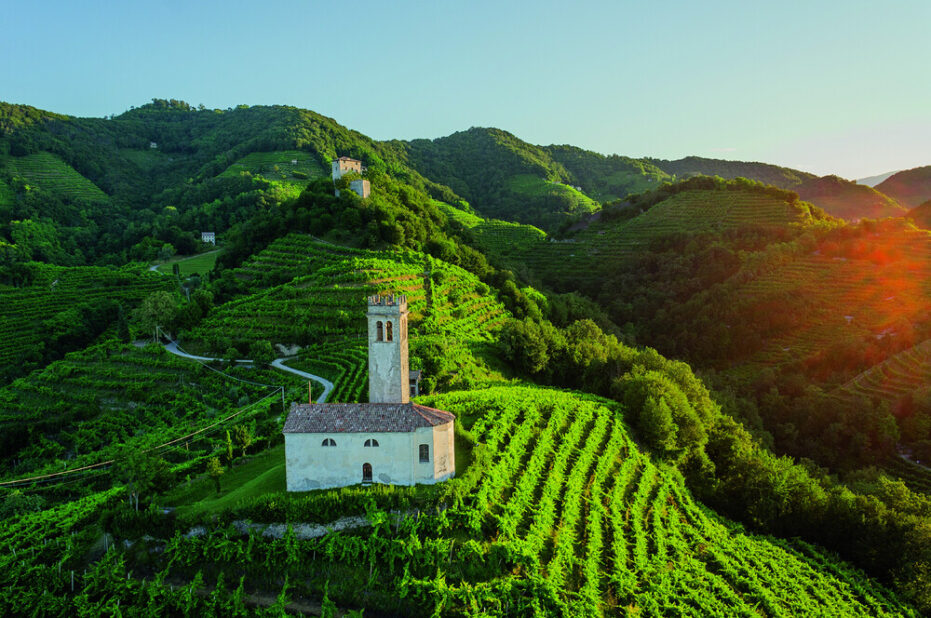
La Farra is a winery established by the Nardi family in 1997 at Farra di Soligo, in the heart of Prosecco Superiore Conegliano-Valdobbiadene DOCG. This DOCG is the larger of the two high status appellations responsible for the best Prosecco sparkling wine, as suggested by the addition of the name Superiore.1
This is a very beautiful part of the Veneto, being both verdant and vertiginous. Since 2019, the Conegliano-Valdobbiadene area has also been classified as a UNESCO World Heritage site. The spectacularly steep and high vineyards on green hogback-shaped hills often involve truly heroic viticulture, particularly around Valdobbiadene. That’s in sharp contrast to the majority of Prosecco DOC, which is mostly grown on flat land.
Rather than repeat the details about this DOCG, you can read all about it in a previous Wine Alchemy article here. Suffice it to say here that the DOCG wines represent the best that Prosecco can be.
A brief reminder about the Charmat/Martinotti method
Most Prosecco uses 100% Glera grape variety (the minimum for DOC and DOCG being 85%). For the base wines, the grapes are fermented in stainless steel to make a still base wine. The second fermentation to produce the bubbles then takes place in a stainless steel pressure tank known as an autoclave. Maturation, filtering and bottling is then conducted directly from the autoclave.
This technique can make batches of sparkling wine quickly and relatively inexpensively, but also it allows for batch consistency and precise control. Additionally, for aromatic grape varieties such as Glera, this method gives better results than the more expensive Metodo Classico with bottle fermentation. The aim here is to preserve grape freshness, delicacy and, above all, aroma. Prosecco is always at its best when young as it’s not designed to age further.
While the cheapest Prosecco can be made in under a month, the best wines use slower and longer fermentation times, and resting on the lees to maximise aromatics and flavour. A dosage can be added (or not) to the batch prior to bottling and that determines the level of sweetness.2
La Farra
La Farra Make a range of Prosecco sparkling wines. Six of them are designated DOCG, and three of these are featured here. There are also four DOC Treviso wines. Their one still wine is a small amount of inherited old vine Pinot Grigio, as the family roots in local winemaking date back to the Great War. In total, the La Farra vineyards span 27 hectares. 18 hectares is DOCG, with a further 9 ha of DOC Treviso – so all the vineyards are high quality sites making artisanal style wines. Production is 700,000 bottles per year of which 16,000 bottles find their way to the UK.
All the farming is by hand, with much of the land being on very steep slopes where only manual toil is possible. Glera is a very productive variety, but keeping yields lower in the DOCG really helps improve quality. Sustainability is not an afterthought here, it’s embedded in the philosophy of the Nardi family and perfectly complements the natural beauty and UNESCO recognition. Hence faming is organic and certification is by both SNQPI and Equalitas.
The Wines
All three examples below were well chilled to around 8°C. Serving was in white wine glasses, in preference to flûtes to express the aromas.
Valdobbiadene Prosecco Superiore DOCG, Millesimato BRUT, 2025. 11%

Brut
As this wine is entirely made from grapes grown near Valdobbiadene, the word Conegliano is not shown on the label, as is allowable. This is also a vintage dated (millesimato) wine. Most Prosecco is not vintaged, as its made in batches to keep fresh for market demand and fluctuations, so while it might show a lot number, it won’t have a vintage stated. With millesimato, a vintage date is shown, so you can easily check the age of the wine. This is preferable given that Prosecco is best drunk during the year after it was made.
The 100% Glera grapes are a selection from the La Farra vineyards in Farra di Soligo and the nearby hamlets of Farrò, Solighetto and San Pietro di Feletto. The soils are a mixture of clay and limestone at 180 – 300 metres altitude.
The harvest is by hand in the last ten days of September. The first fermentation lasts approximately 15 days, at a controlled temperature of 18° C. The new base wine is then racked and stored at low temperatures in stainless steel tanks. The second fermentation is then in autoclave, lasting around 25-30 days at a temperature of 16-18°C. This then matures in the autoclave on the lees for 3-4 months, before filtering and bottling. The Brut style has a small dosage to leave residual sugar at 10g/l to balance the high acidity with a gas pressure of 4.8 Bar.
Tasting
Pale silver in the glass, with a large white mousse underpinned with fast rising bubble streams. The floral aromas are striking and long lasting: broom, jasmine and chamomile, and, most curiously, buttercup. there are a large amount of buttercups in the garden at the present time, so this scent was easily confirmed. The palate is super-fresh and crisp with green apple and peach fruit at the forefront. The bubbles are mouth filling and theres also an excellent and satisfying persistence, finishing dry and clean.
Food matching
Excellent as an apèritif, this wine also goes extremely well with Risotto. My personal favourite match was with Arancini, which at first seems unlikely but the acidity cuts through the deep fried layer to the rice and mozzarella within.
The UK Importer is Alliance Wine. Stockists include Three Pillars Wine, Steep Hill Wines and The Olive Branch Pub Shop for £18.00.
The two wines below are technically of even higher quality, as they are a Rive, in this case Rive di Farra di Soligo, a specific locality. Again, both are millesimato.
Essentially, this is one wine made in two contrasting styles by varying the dosage. There’s Extra Brut (the driest) and Extra Dry (with some gentle sweetness). Rather than write separate repetitive reviews, let’s contrast the two styles. And do check the label – it’s very easy to mistake Extra Brut and Extra Dry on otherwise identical labels!
Valdobbiadene Prosecco Superiore DOCG, Rive di Farra di Soligo, Millesimato, 2025. 11.5%.
EXTRA BRUT and EXTRA DRY
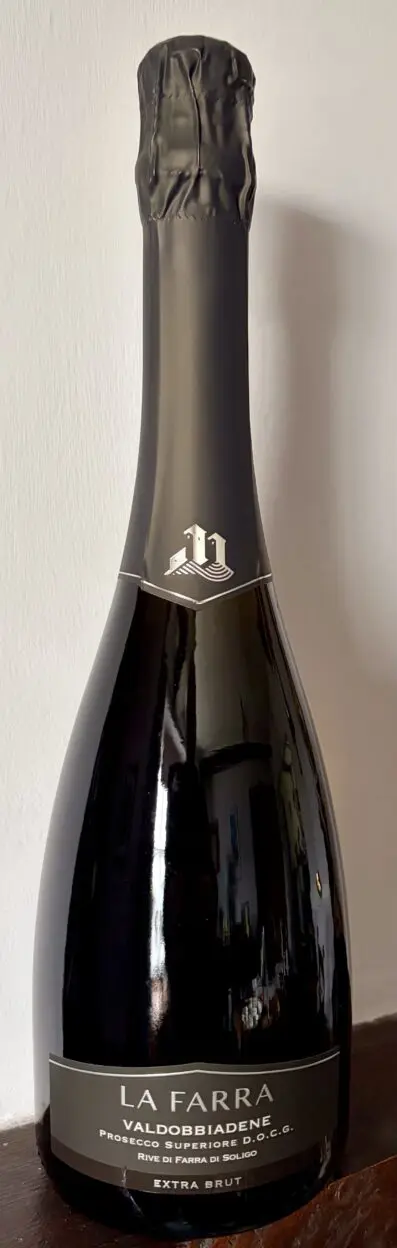
Rive Extra Brut
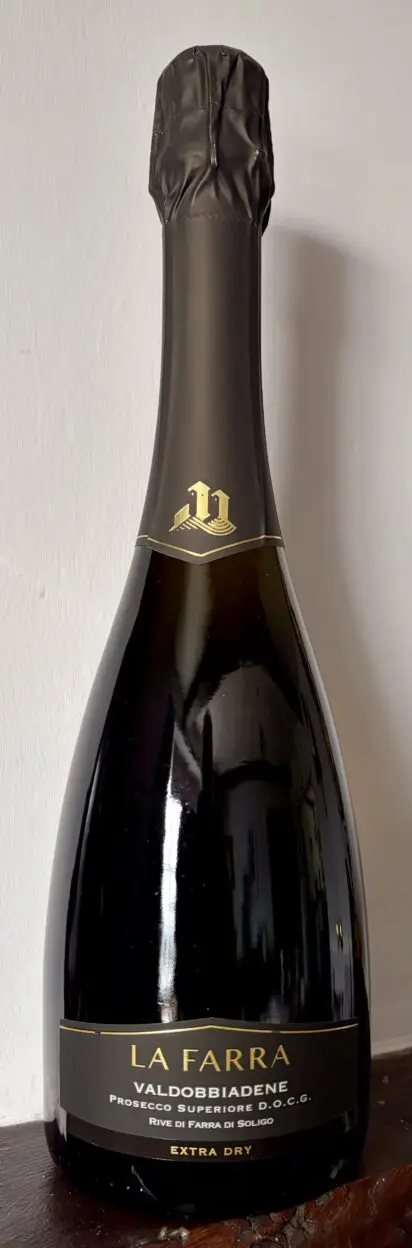
Rive Extra Dry
Produced only with 100% Glera from the “Rive dei Nardi” vineyard, situated in the upper hills of Farra di Soligo in the hamlet of Collagù. This is part of the Rive di Farra di Soligo, where the grapes achieve a little more ripeness and yields are lower. The soil is a mixture of clay and limestone at 220-300 m altitude. The harvest is by hand, again in the last ten days of September. The wine making process is exactly the same as for the Brut shown above. However, there’s a slightly higher 5 Bar of pressure and 0.5% more alcohol, reflecting better ripening conditions in the Rive.
Both wines are identical in pale silver colour and in the white mousse, so a strong resemblance to the Brut shown above. Again, the bubbles are small and leave a very attractive prickle in the mouth. However, the aromas are slightly more prominent and subtly different. Broom and chamomile, but with the appearance of rose and geranium. As the winemaking is the same, this is perhaps attributable to the Rive site. The palate is a little denser, with slightly more weight, with peach at the forefront and hints of green apple.
Extra Brut vs Extra Dry
The real difference of course is in the sweetness. The Extra Brut has none, slightly austere in comparison, acidity more to the fore and a crisper dry finish that shows a final mineral sensation. The Extra Dry is gently sweet that offers a longer softer texture.
Choosing between them is a personal preference, or maybe dependant on mood and occasion.
The key difference is that the Extra Brut has no dosage, with only 5 g/l of residual sugar, while the Extra Dry has a dosage to added to leave 17 g/l of residual sugar. The Extra Brut is a “naked style” which is arguably more revealing of its origins, and, by the same token, would be more revealing of any faults, of which there are none.
The Extra Dry has enough dosage to make it an off-dry, gently sweet style. This isn’t to mask the aroma and flavour in the wine, but instead enhances the silken texture in what remains the most recognisable and popular style. It really demonstrates how dosage can make the same wine into a very different expression and this also means that each of the wines have different food matching capabilities.
Food pairing
Serve both wines on their own, or with a range of hors d’oevres. The Extra Brut suits salads, and light savoury dishes such as Burrata, Risotto or freshwater fish. The Extra Dry is an ideal partner for light desserts such as Pannacotta and fresh fruit, or with biscuits and Pannetone. Curiously, Prosciutto Ham works with both styles, as it’s the classic match of salt and sweet. And yes, Arancini too!
At present, these two wines are not yet in the UK, but this situation should change in future.
And Finally
The UK drinks a lot of Prosecco. But such success is a two-edged sword. Volume brands and supermarket discounting dominate the market. Such ubiquity commoditises Prosecco, risking it being thought of only as mere frivolous froth even when made by quality conscious winegrowers.
Prosecco DOCG offers a genuine increase in quality and value for relatively little extra outlay. The La Farra wines featured here are excellent examples that demonstrate why Prosecco DOCG is superior.
Moreover, they are truly fine wines of joy!
Location
Azienda Agricola La Farra
Via S. Francesco, 44
31010 Farra di Soligo
Treviso
Veneto
Italy
What3words Location
Notes
- The enormous Prosecco DOC has over 36,000 hectares of vines, spanning much of the northeast Italian region of Veneto and all of Friuli-Venezia Giulia. Within this there are excellent producers and wines, particularly in the two DOC subzones at Treviso and Trieste. However, Veneto has two higher rated Prosecco Superiore DOCG enclaves: Asolo (2,271 ha) and Conegliano-Valdobbiadene (8,683 ha).
- The DOCG regulations allow the sparkling Superiore to have four sweetness levels, internationally-defined. These are Extra Brut 0-6 g/l, Brut 6-12g/l, Extra Dry 12-17 g/l, and Dry 17-32 g/l.
My grateful thanks to Adamaria Nardi of La Farra for sharing and explaining the wines! I hope to see more La Farra wines in the UK in future.