

Les Crêtes – Petite Arvine – An Ode to Joy
You could be forgiven for assuming that the Les Crêtes winery, run by the Charrère family, is French. In fact, this is an Italian producer based in the Valle d’Aosta, the autonomous Italian region bordering France and Switzerland.
For many, the Aosta Valley provides the first experience of Italy when travelling through the Alps from France. Just take the easy convenience of the Mont Blanc Tunnel from Chamonix.
Before Italian Unification, Aosta was a part of Savoy, a pan-Alpine Kingdom which spanned France and Italy. Hence, while very much Italian, French is widely spoken and both are official languages. Aosta is also a fusion of Italian and French cultures, including wine and cuisine.
Welcome then to Italy’s smallest and least populous wine region. Here lie some of the highest and most spectacular vineyards in Europe, rising to over 1,200 metres to where the snowline intercedes. In a land of peaks and glaciers, only 5% of the land is flat. Such mountain winegrowing is often truly heroic, laborious and fatiguing. It is not for the faint-hearted.
Valle d’Aosta
The earliest surviving winegrowing document dates back to 1032. However, there is archaeological evidence of Bronze Age viticulture that became widespread in Roman times. The founding of the main city of Aosta was by a strategically placed Roman colony, Augusta Prætoria Salassorum.
This land might seem a strange place to grow grapes, yet it’s always been on a major trans-alpine route where travellers would need refreshment. And while the conditions are extreme, the resulting wines can be spectacular. The vineyards reached their maximum extension under Napoleon. Afterwards, they went into decline, thanks to phylloxera, fungal diseases, urbanisation and cheaper alternatives.
The situation began to improve in 1951. This is when the École Pratique d’Agriculture established wine research and training, focusing on quality rather than quantity. Cooperatives became established in the 1970s. The first DOC was Donnas, in 1971, followed by Enfer d’Arvier. Those two areas became subzones when the larger all-encompassing Valle d’Aosta DOC was established in 1986.
The vineyards follow the valley of the main river, the Dora Baltea. This river rises in the far west, on the slopes of Mont Blanc (Monte Bianco), and soon the first, and highest, vineyards appear at Morgex. From here, the vineyards stretch downstream for 70 Km, passing Aosta, continuing down to Donnas and the Piemonte border in the east.
Terroir
Most vineyards hang precariously on rugged slopes and terraces made of thin sands and clays deposited by rivers and glaciers. They are predominantly on the left bank of the river, where vines are often trained on low pergolas. These face south to catch the sun and retain heat at night. Also, the valley is relatively dry, as it lies in a rain shadow created by the surrounding mountains and glaciers and is prone to breezy winds. This ardet location has bitterly cold, long winters yet blazingly hot, short summers with large day-night temperature swings. The right bank, enfer, has fewer vines, apart from around the town of Aosta, where the valley is wider. Due to the unpredictable climate, vintage variation doesn’t so much affect quality as impact the quantity of grapes available.
In the highest vineyards at Morgex, the soils are too cold for the phylloxera insect to survive, so there are still ungrafted vines. As the river descends, the valley broadens and the growing season lengthens. Hence, whites are dominant in the west, and slowly yield to the reds in the east.
There is only one appellation, Valle d’Aosta DOC. It occupies 350 hectares of a total vineyard area of just 475 hectares, with 46 producers in the Consorzio.1
Six of those producers are cooperatives, responsible for 75% of the wines. The remaining 25% is from small to medium-sized wineries, mostly family-owned.
Yet with a total of about 2 million bottles made per year, many Valle d’Aosta wines are available in only small amounts, a mere drop in a vast Italian ocean. No wonder many of them seldom appear outside the region. There may be only 122,000 inhabitants in this region, but local consumption is multiplied by tourism and winter sports.
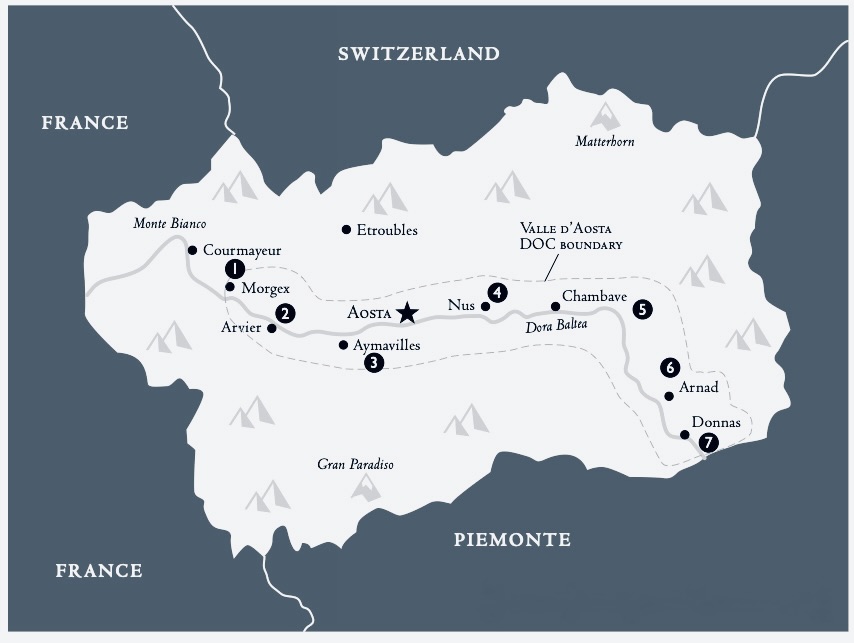
Valle d’Aosta DOC & seven subzones (see text)
Subzones
While there is only one DOC, it has seven subzones. These are shown on the map.
1. Blanc de Morgex et de La Salle
2. Enfer d’Arvier
3. Torrette
4. Nus
5. Chambave
6. Arnad-Montjovet
7. Donnas.
Grape Varieties
Incredibly, the DOC authorises 38 different grape varieties. There’s a mixture of indigenous varieties (including near-extinct rarities) plus those of French, Italian and Swiss origins, including internationals. Here they are (with the six most commonly found highlighted).
Whites: Chardonnay, Petite Arvine, Prié Blanc, Gewürztraminer, Viognier, Marsanne, Roussanne, Erbaluce, Sauvignon Blanc, Incrocio Manzoni 6.0.13, Bianco Comune, Müller-Thurgau, Moscato Bianco, and Pinot Gris (aka Malvoisie).
Reds: Pinot Noir, Petit Rouge, Fumin, Prëmetta (Prié Rouge), Bonda, Cornalin (aka Humagne Rouge), Crovassa, Cabernet Sauvignon, Gamaret, Mayolet, Merlot, Petit Verdot, Vien de Nus, Ner d’Ala, Roussin de Morgex, Neret de Saint-Vincent, Vuillermin, Dolcetto, Grenache, Granoir, Syrah, Gamay, Freisa and Nebbiolo (a biotype called Picotendro).
60% of production is red, yet there’s an Italianate mix of styles to broaden the vinous palette further. As well as white and rosé varietal wines, there are blends too. Then add sweet late harvest and passito dessert wines and Metodo Classico sparklers.
With such diversity in such a small area, it’s understandable that there are no IGTs here. Any wines not covered by the single DOC will be Vino de Tavola.
With such natural gifts, exceptional wines are the norm, not the exception. Indeed, whether taken together or singly, they are an Ode to Joy, more of which anon.
While it’s invidious to select only one of the 46 producers as an ambassador for the region, the need for brevity in this article demands it. Hence, I nominate Les Crêtes to shoulder the burden of representation on this occasion. Their range of 24 wines includes eight whites, thirteen reds, a rosé and two sparklers, and many of them are available in the UK.
Les Crêtes
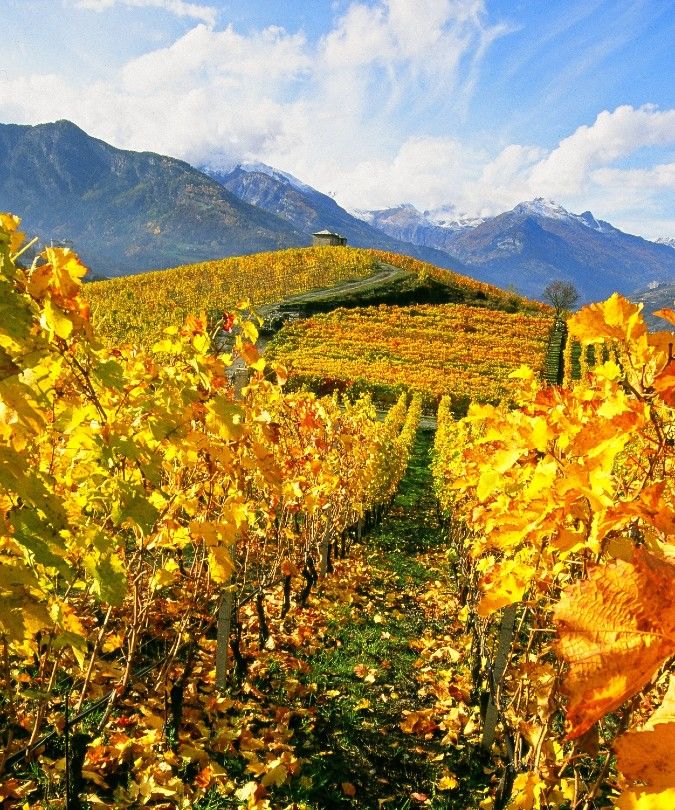
Autumn in Aosta
Les Crêtes is based at Aymavilles, a village just upstream from Aosta. On the SR20 between Aosta and Aymavilles, there rises a small pyramidal hill covered in vines and topped by a farmhouse; it’s a local landmark. This is Les Crêtes.
While the Charrère family came here from Grenoble in 1750 and were making wine by 1800, it was principally a mixed farm with vines, cereals, a watermill, cider and a walnut oil press. Constantino Charrère started winemaking in 1970, learning from his Father, and enjoyed great success in Italy with a red wine called La Sabla, made with Cornalin.
Les Crêtes, as a wine business, was created by Constantino in 1989, which helped showcase the terroir’s potential to the world. Successful from the outset, the wine that gained international recognition and renown was Cuvée Bois, a brilliant barrel-aged Chardonnay first made in 1995 – at a time when Chardonnay was arguably reaching its apogee of success. The Les Crêtes business is now run by his family descendants, who have continued a legacy of championing terroir with local and native grapes as well as international varieties, all in tandem with sustainable business practices.
They have a total of 35 hectares of vines containing sixteen different grape varieties, so making about 250,000 bottles per year. Those vines are spread in 180 individual plots across 11 municipalities in the valley, between 500 and 900 metres in altitude. The vineyards are therefore spread widely and require multiple journeys. Being small and on steep slopes, mechanisation isn’t possible. This situation means a lot of work in the vineyard and the winery, but that has paid off handsomely as regards quality and value.
Sustainability
Les Crêtes also has excellent sustainable credentials from grape to glass. There’s respect for the environment, people, and biodiversity. Plus energy conservation, renewable energy production and sustainable packaging. For starters, they are SQNPI certified. Then, there’s their solar and hydro power. Sustainable packaging is an important theme, with lightweight glass bottles and Nomacorc Select Bio zero-carbon closures. Finally, there is also a high-quality natural cosmetics line called DeVin, which uses the spent grape pomace – the perfect way to recycle.
Time for a short interlude.
An interlude with Rocco Schiavone

Rocco Schiavone
If you are as intrigued by the Valle d’Aosta as I am, perhaps you have seen the Italian TV series Rocco Schiavone, shown in the UK on Channel 4’s Walter Presents slot as Ice Cold Murders. This is based on the books by Antonio Manzani, available in an excellent English translation.
Rocco, played by Marco Galliani, is a dour Deputy Police Chief, exiled from his beloved Rome to Aosta for disciplinary reasons. His mobile ringtone is Ode to Joy, part of Beethoven’s 9th Symphony.
In the first book, Black Run, Rocco is visited in Aosta by Sebastiano, a shady friend from Rome with gourmet tastes. In the Trattoria degli Artisti Pam Pam in Aosta, Sebastiano orders a bottle of Les Crêtes. 2
Admittedly, we don’t know which bottle of Les Crêtes was chosen, but I’d have chosen the Petite Arvine.
So here it is.
Les Crêtes, Petite Arvine, Valle d’Aosta DOC, 2025. 14.5%
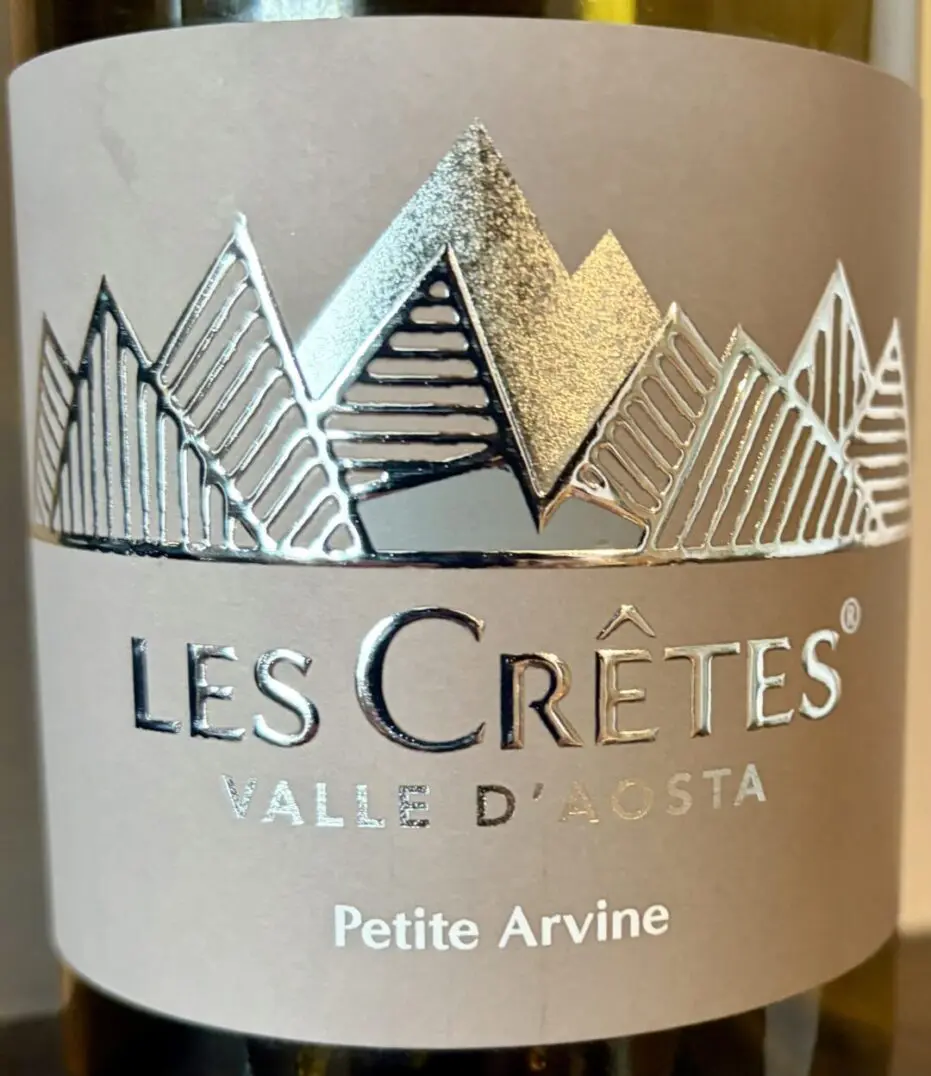
Les Crêtes Petite Arvine
Technical
Petite Arvine may (or may not) have Swiss origins in the nearby Valais, but this white grape is emblematic of Valle d’Aosta, and is a late-ripening variety. Hence, harvested by hand in mid-October from three plots, namely Champorette and Bufferia (at Aymavilles), and Frissonnière (at Saint-Christophe, Aosta). at 500 and 750 metres altitude. Whole bunch pressed, then fermented for 12 days in stainless steel, at 14°C. Aged on the lees for 2 months. Lightweight glass bottle sealed with Nomacorc Select Green 100. 42,000 bottles made.
Tasting
In the glass, a youthful starbright yellow-silver. Lovely aromatics, primarily Jasmine, are worth lingering here. The palate shows apple, yellow plums and citrus with a real depth of flavour, and a hint of pineapple. The fruit complexity and fresh saline acidity are balanced by powerful yet unnoticeable alcohol. Nothing flabby, nothing sharp, just soft and poised, with a long, dry and satisfyingly stony finish. A delightful wine that’s robust enough to stand up to the local cuisine, whether that’s of a delicate or hearty nature. A fingerprint of this place, truly An Ode to Joy.
UK availability
Xtrawine, (2025) £20.00. Woodwinters (2024), £27.00.
Food
Try Trout Carpaccio, Tuna with Pesto, or sushi/sashimi. Tartiflette (in its Italian Valdostana version, using Italian Fontina rather than French Reblochon cheese) would also hit the spot.
And Finally
And what would Rocco Schiavone say about this article? “Fatti, non chiacchiere”. Facts, not talk. Probably thinks it’s a first-class pain in the ass. Then he’d take another glass of wine and smoke yet another cigarette.
Location
Les Crêtes Wine Production and Sales
SR20, 50
11010 Aymavilles
Aosta
Valle d’Aosta
Italy
What3Words Location
Notes
- My thanks to the Consorzio Valle d’Aosta DOC (established in 2022) for background facts and figures.
- Black Run (Pista Nera). The first of the Rocco Schiavone mystery series by Antonio Manzini, published by HarperCollins, ISBN 9780008119034. Sebastiano always carries a copy of Gambero Rosso for recommendations. The Trattoria actually existed and had an excellent reputation until it closed down due to Covid. The building is now a set of holiday apartments instead.