
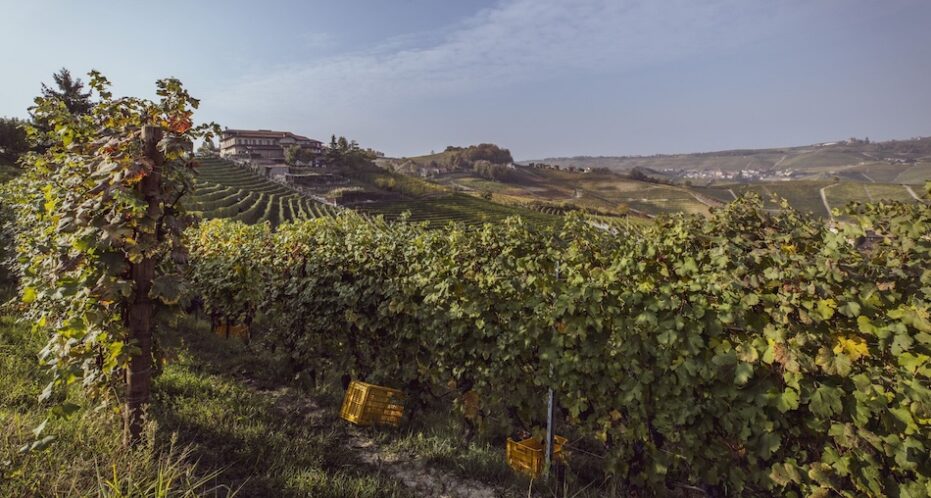
Parusso 100 Mesi Extra Brut – Ancient Yet Contemporary
The Parusso estate is at Monforte d’Alba, with a stellar reputation for great Barolo DOCG, one of the world’s greatest red wines. Meanwhile, Monforte d’Alba is one of the major wine villages of the Barolo DOCG. It has previously featured on these pages several times, and is one of my favourite locations in Piemonte. Perhaps that’s because this was the place where I first really “got into” Barolo DOCG. Then again, this medieval hilltop town of 2,000 inhabitants is also charmingly photogenic, being an I Borghi Più Belli d’Italia, or one of the Most Beautiful Villages in Italy. In addition, its vineyards, stretching down the famous Cru Bussià ridge towards Castiglione Falletto, are also part of a UNESCO World Heritage site.
Or maybe it’s also because of all the other possible wines that can be found here alongside Barolo DOCG. Many of them are made with the same grape variety, Nebbiolo, yet offer different expressions, experiences and prices. Perhaps the rarest and most unusual example of this is Parusso’s Sparkling Wine made from Nebbiolo!
Nebbiolo Sparkling wine
Parusso makes two cuvées of sparkling wine with Nebbiolo, both using the Metodo Classico process bequeathed to the world by Champagne. Of the two, the top bottling is the Rosé featured here, Extra Brut 100 Mesi. The Vintage 2015 edition was recently released to the market in December 2025. With its black label, you may see it listed as Etichetta Nera, with the name “100 Mesi” only shown around the neck of the bottle and on the back label.
So, can you really make a world-class sparkling wine from a red grape variety known for its aromatics, longevity, early budding and very late ripening? Not forgetting high alcohol and massive tannins? Time to find out, but first, a little context about the Paruso winery.
Parusso
The Parusso family estate dates back to 1901. The wines began to be bottled and released under the Parusso label in 1971. Located in Località Bussia in Monforte d’Alba, it now produces about 150,000 bottles per year from 23 hectares of vines in the Monforte d’Alba and Castiglione Falletto parts of the Barolo region. The focus is on the red native grapes Nebbiolo (in particular), plus Dolcetto and Barbera, while their white grape is the international Sauvignon Blanc. There are fourteen different wines in their range, including seven expressions of Barolo DOCG, of which three are “Cru” wines.
As far as sparkling wine goes, there is some evidence suggesting that sparkling Nebbiolo was being made in the region back in the Eighteenth century, though whether it would have used the then-new-fangled “Champagne Method” is not known to me. Presumably, this style died out as the region’s winegrowing and reputation gradually evolved.
Hence, the desire at Parusso was to rekindle ancient traditions and to give the estate’s Nebbiolo an unusual, contemporary appearance. The result was a “sparkling wine sporting a delicate pink hue that evokes, year-round, the magical summer sunsets of this place”. This wine from Parusso is not the only Sparkling Wine made with Nebbiolo (for example, I have encountered one or two in Valtellina, in Lombardy, and in Nebbiolo d’Alba), but they are certainly unusual. The first release was in 2010.
There’s no DOC or IGP designation used. Hence, it’s labelled as a Vino Spumante di Qualità1.
Parusso, Metodo Classico Extra Brut, “100 Mesi”, Vino Spumante di Qualità, 2015. 12.5%
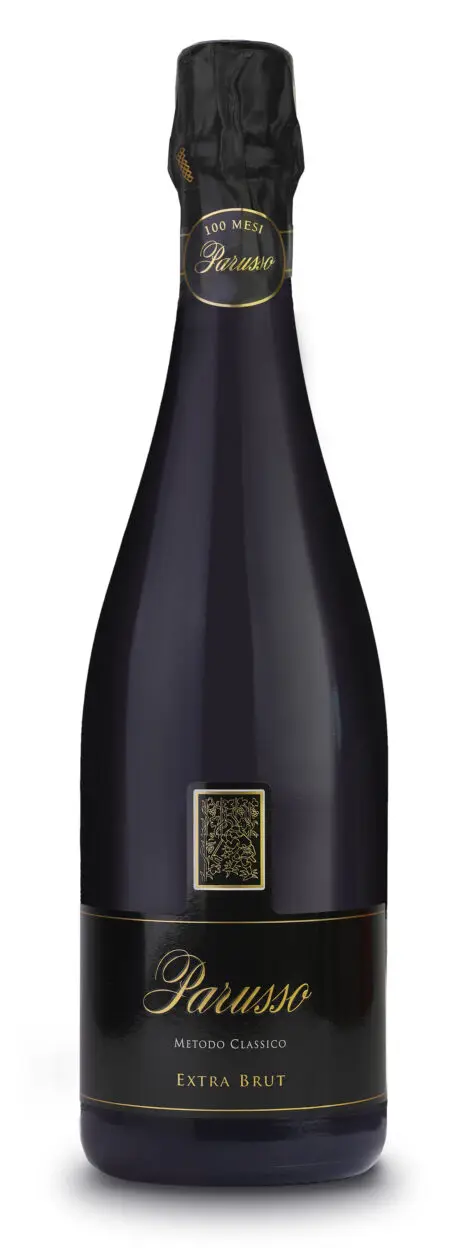
Parusso 100 Mesi
Technical
A selection of Nebbiolo grapes from 2015 was early harvested in late August and left to rest in the cellar for a few days at controlled temperature and humidity. Harvesting at this stage means that the grapes are technically unripe, with high acidity, little sugar and potential alcohol. However, that situation is optimal for sparkling wine. The still base wine (vin clair) was vinified using native yeasts, and using only the free-run must, with minimal skin contact and no press-juice. This gives the rosé colour by the “saignee method” and, very importantly, leaves the tannin behind. It’s also a major limitation on the amount that can be produced.
The Second fermentation with tirage is then in the bottle using Metodo Classico. Exceptionally, the wine is then kept on the lees in the bottle for 100 months until disgorgement (no date is given for this, which I’d like to see shown on the label). During this time, riddling (remuage) is undertaken by hand. As it is made in an Extra Brut style 2, it’s assumed here that little or no dosage containing sugar was needed for balance at disgorgement. In the 2015 vintage, just 1,300 bottles were produced, including 100 magnums, sealed using DIAM Mytik corks. The first release was in 2010.
Tasting
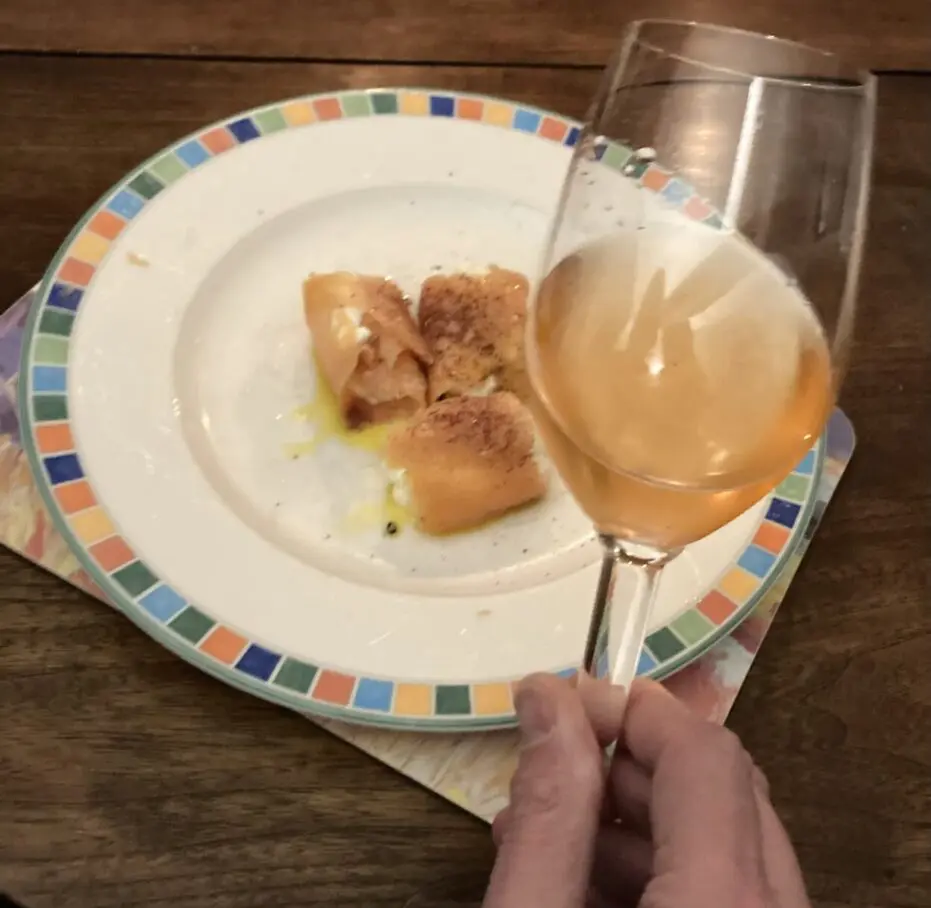
Chill to 8-10 degrees, as usual. In the glass, the colour is a glorious salmon pink – see the accompanying photo. You’ll find onion skin and copper tints as well. There’s an attractive foaming mousse, and tiny bubble streams rise languidly. Rose scents suggest Nebbiolo, but there are also hints of Kumquat and citrus. The palate boasts firm structure, elegance, and the promise of longevity and further development. All that is down to the enticing acidity, offering a silken texture and a perfect balance achieved with the alcohol and redcurrant fruit. There’ complexity from a subtle level of yeast influence showing as a fresh bready note. This is, by any measure, an outstanding sparkling wine. Finally, the wine finishes dry and clean, and refreshing, leaving a final memory of a subtle saline sapidity.
100 Mesi
Food
This is a Rosé that can be drunk as an apertivo, but Extra Brut really deserves food to shine best. This example was paired with smoked salmon and cream cheese, garnished with sumac, oil and lime juice. It proved an outstanding match, right down to the colour. Mushroom, tomato and pepper Bruschetta also proved excellent. It would also be perfect with salads, roasted veggies, and salumi. Or try with light desserts such as Eton Mess.
UK Stockists
Currently, the 2012 vintage is in stock in the UK, at about £50 per bottle, duty paid and available in cases of six. Given the bottle price, this is stupendous value! Stockists include Ideal Wine, Avint-Garde and Cru World Wine.
And Finally
This rare and limited edition is the fruit of a precise and rigorous vinification process, including 100 months’ ageing on the lees, resulting in a wine of extraordinary complexity and depth. To reiterate: this wine offers so much more than mere novelty, and it has now garnered a huge number of prestigious awards. Heck, it’s still the beginning of 2026, but I’ll probably not taste a better Rosé sparkling wine this year!
As I never tire of repeating, there’s much more to the Barolo area than just Barolo DOCG. With my tongue firmly in my cheek, may I suggest that Barolo DOCG extend their rulebook to embrace sparkling wines like this?
Location
Parusso Armando di Parusso F.lli
Loc. Bussia 55
12065 Monforte d’Alba (CN)
Piemonte
Italy
what3words Location
Notes
- Quality Sparkling Wine. There are still measurement rules governing production, such as a minimum gas pressure of 3.5 Bar, a minimum total production time of 9 months and a base wine alcohol minimum of 9.5% abv. This does not mean that it’s of lower value than those that fall within a denomination. Nebbiolo d’Alba DOC might be a potential fit, but their Nebbiolo sparkling wines include the Charmat method, and it isn’t well known anyway.
- Extra Brut rules state that residual sugar is between 0 and 6 grams per litre. This is also a full Spumante in style, so gas pressure will be 5-6 atmospheres.