
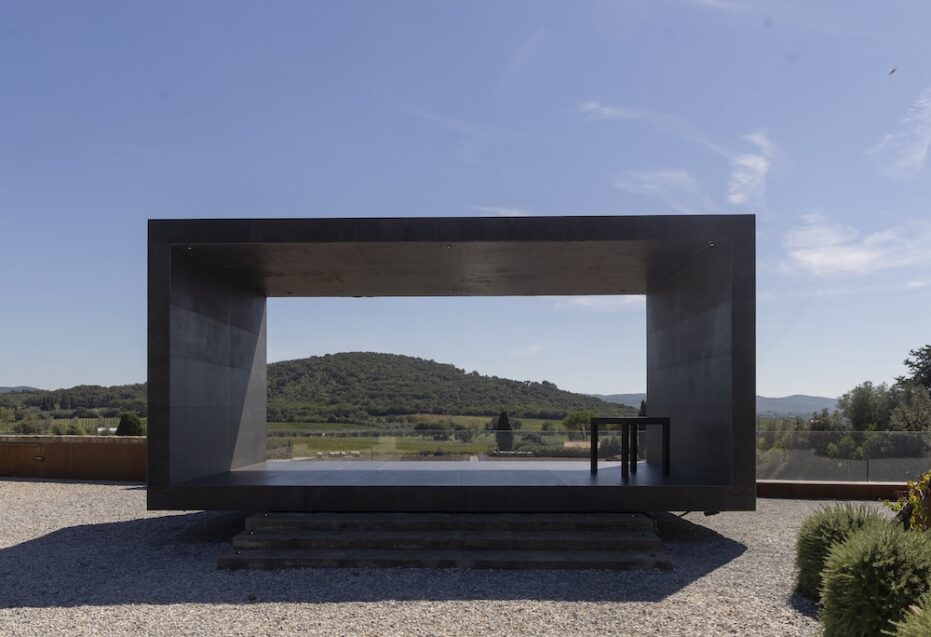
Tenuta Casadei – Famiglia Casadei, Part Two
In Part One of this three part feature on Famiglia Casadei we met the Casadei family and their four wineries united by BioIntegrale farming. It also covered the wines of Tenuta Olianas in Sardinia. Now, in Part Two, we turn to Tenuta Casadei, at Suvereto, in the Alta Maremma of Tuscany.
Only thirteen km from the Tyrrhenian coast, beautiful Suvereto expresses a premium Tuscan identity that is luminous and open to the sea. This is the highest part of the Maremma, so there’s constant ventilation that helps moderate the heat. The rolling hills have Iron-rich clay soils but there’s sands, gravel and limestone too, so the soils to suit a range of grape varieties.
Tenuta Casadei
Tenuta Casadei was established from scratch in 2000, being the family’s first venture away from their home at Castello del Trebbio. This estate is co-owned with Cline Family Cellars, who are excellent wine producers in California’s Sonoma Valley and also import Casadei’s wines. Indeed, Cline was a “Rhone-Ranger” pioneer in the 1990’s.1 Importantly, both families share the same values.
Since the boom here around the Millennium, this land is frequently planted with French classic varieties and now has no shortage of prestigious wines, with considerable freedom on winegrowing. No surprise then to find that Tenuta Casadei grows grape varieties that include Cabernet Sauvignon, Cabernet Franc, Syrah, Merlot, Grenache and Petit Verdot in red, and with Viognier in white.
There’s around 80,000 bottles from its 16 hectares, all produced using their BioIntegrale system, with a roster comprising a dozen different wines. That includes three wines in the Le Anfore di Elena Casadei range using Georgian Qvevri and Florentine terracotta amphorae.
The winery is underground on three sides, which offers natural temperature control and low environmental impact. Solar power ensures renewable energy autonomy. Vegetable gardens, olive groves, and uncultivated areas complete an agricultural ecosystem designed for resilience.
The wines
The focus here is on two wines, one white and one red. Both these wines are single varietal expressions, called Filare, which means vine row. The Filare number attached (here either 23 or 18) refers to the vine row in the vineyard where the specific grape variety planting begins.
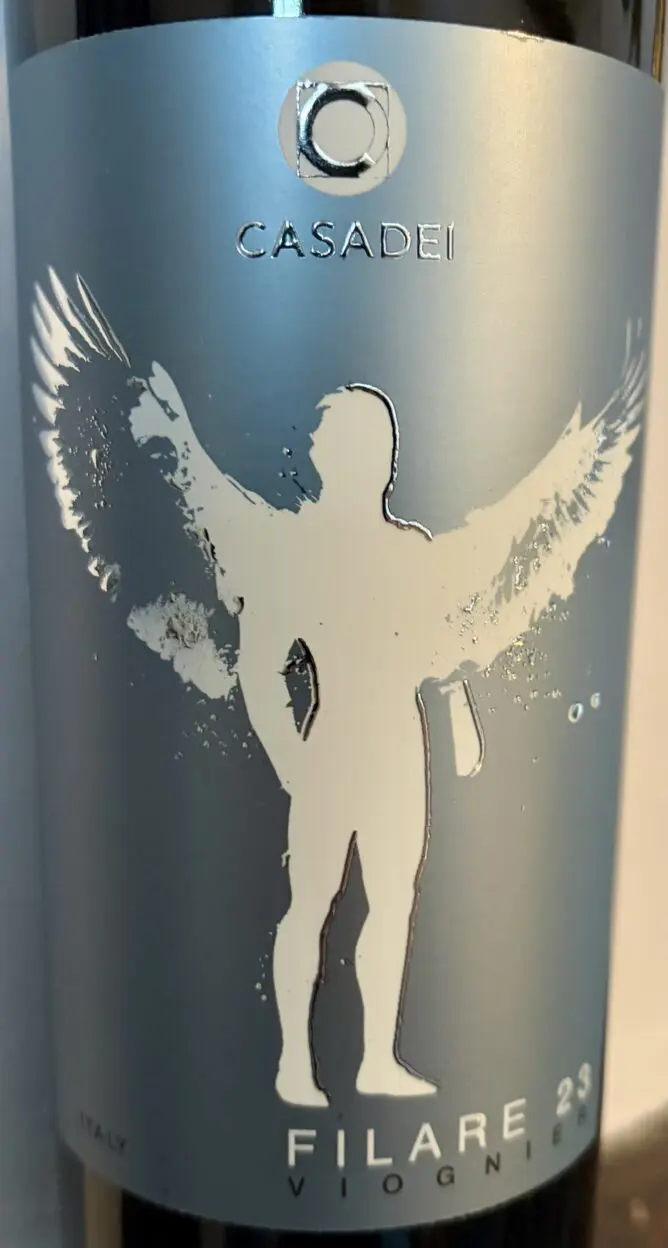
Filare 23 Viognier
Filare 23, Viognier, Toscana IGT Bianco, 2025. 12.5%
Technical
100% Viognier, grown on mineral-rich schistous soils, planted in 2010, and certified Organic. The hand-harvest is early, in late August, so the wine reaches only a moderate 12.5% alcohol – an important point given that Viognier is known for big alcohol and has a tendency for insufficient acidity.
Crates containing the bunches are cold-stored for 24-48 hours, then destemmed and pressed. The juice ferments in 500 litre new oak tonneaux for fermentation, with 30-50 Kg of fresh whole grapes then added to the fermentation to enhance fruit flavours. It then matures in the same new wood on the lees and is clarified with Bentonite before bottling under a natural cork. There is no acidification or acidity adjustment. Only 2-3,000 bottles per annum.
Tasting
Serve chilled, but note that in my opinion that this is a white wine with quite a narrow serving temperature window. Serve too cold and you’ll miss the subtlety and delicacy, so try 10-12℃. Lightly golden-flecked in the glass. Tell-tale peach and apricot fruit on the nose and palate, with an hint of musk and an almond finish. It’s subtle and lithe, with moderate alcohol and a surprising amount of fresh acidity, and without overt wood flavours, all welcome traits. Given the use of new wood in fermentation and maturation, I wonder if it’s no or low toast?
Scents and flavours are light at the moment, though perhaps this wine will put on some weight and complexity with some bottle ageing over the next 5-6 years. It should certainly age well and is best kept at least a year or two yet.
This wine is reminiscent of Condrieu, the original home of Viognier in the Rhône Valley of France. I can’t think of higher praise and perhaps the influence of Cline’s Rhône-Ranger heritage is showing here.
Food
Lobster would be perfect, whether served cold or hot. A plate of fresh grilled prawns with lemon mayonnaise and a rocket salad proved to be an excellent match too.
UK Stockist
Fine Wines Direct UK, £40.95
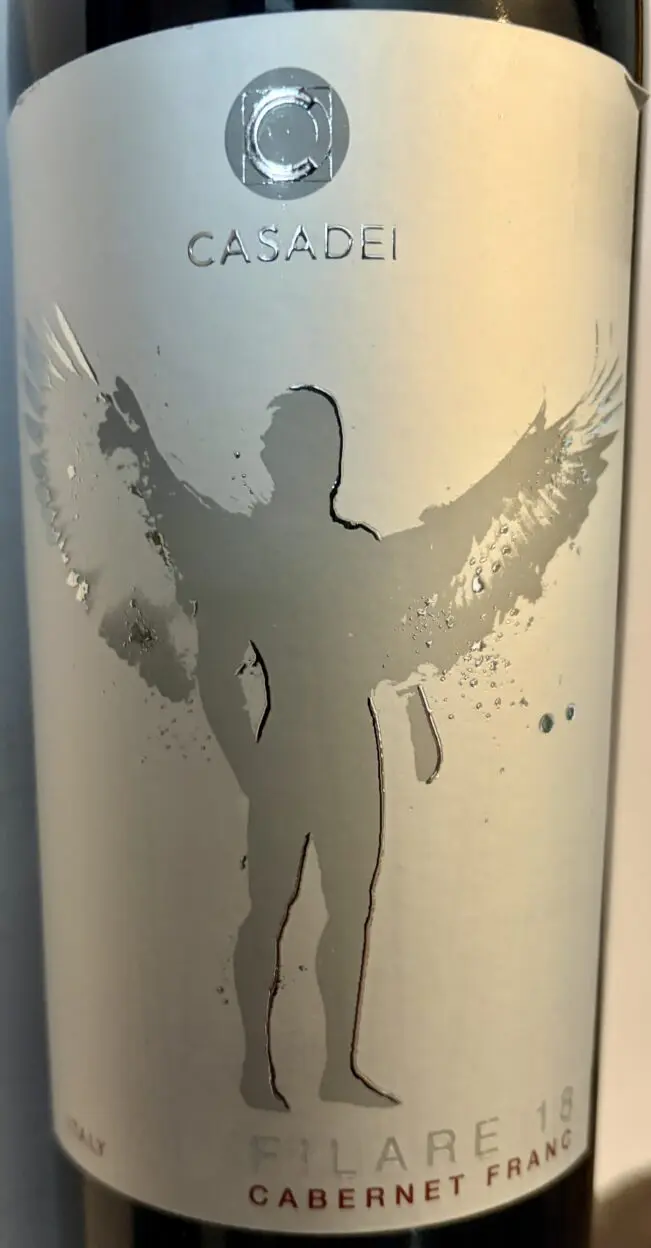
Filare 18 Cabernet Franc
Filare 18, Cabernet Franc, IGT Toscana Rosso, 2022. 14%
Technical
Vines planted in 1999. A single varietal Cabernet Franc, selected by Stefano Casadei from the best barrels from the vintage, certified by Demeter.
The crates of hand-harvested grapes are placed in cold storage at 10 °C for 24 hours and then destemmed, crushed to obtain a slight breaking of the berry, and transferred into 1,000 litre terracotta amphorae which are then buried for 30 days and where spontaneous fermentation takes place. Afterwards, maturation is in new French oak barriques for 18-20 months. Bottled under a natural cork.
Tasting
Decanted for an hour prior to serving. In the glass, an inky black core with a youthful ruby rim. Aromas just leap from the glass, which is genuinely thrilling, blackberry fruit bound with graphite and pencils, plus, as it opened, some attractive wood spices.
The palate is super-intense, opulent and has a rare purity. Concentrated black fruit is bound with alcohol and bright mineral acidity, all poise and finesse. Polished tannins offer structure and texture and will soften further with age. This wine is already drinking well and with promise of more complexity to come during the next decade.
The wood treatment is terrifically well done, cedar and pine notes, a little hazelnut and smoke on a satisfyingly dry finish. A gastronomic wine, lovely now but will repay keeping. Worth every penny.
Food
Boeuf Bourguignon hit the spot, with the obligatory mashed potatoes. Julia Child’s recipe is a famous interpretation, an appropriately Californian influence on a French classic!
UK Stockist
Fine Wines Direct UK, £49.00
And Finally
There’s no doubt that on this evidence, Tenuta Casadei sits on the top table with the very best wineries in the Alta Maremma.
There is an obvious contrast between the modernity of Tenuta Casadei and the traditional (albeit relatively recent) Tenuta Olianas, let alone the ancient stones of Castello del Trebbio. Yet all those contrasts are welcome, with different grapes and terroirs making different wines. What unites them is their excellence and authenticity, unified by BioIntegrale.
Meanwhile, for those who missed it, Part One is here. Part Three, about Famiglia Casadei’s home winery at Castello del Trebbio concludes this story for now and will be available soon.
Location
Tenuta Casadei
Casadei & Cline SSA
Località S. Rocco
57028 Suvereto (LI)
Toscana
Italy
What3words Location
Notes
- Rhône-Rangers. Those influential American winegrowers, often based in California, who planted grape varieties originating in the Rhône valley in France such as Viognier and Syrah. Once seen as contrarian, many of their wines received great acclaim in the 1980s and 1990s.