
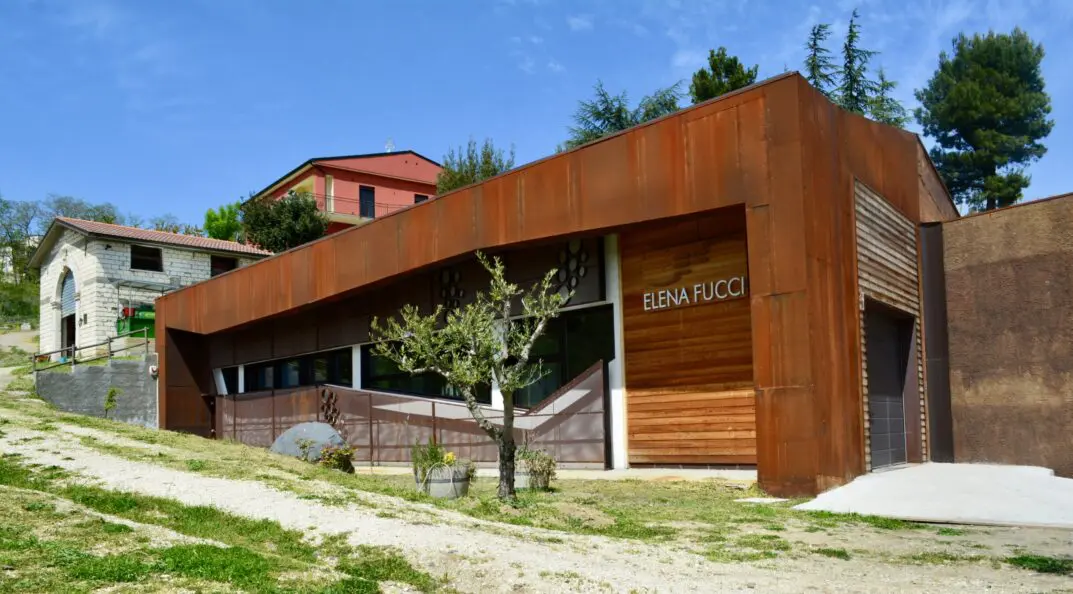
Titolo by Elena Fucci, Aglianico del Vulture
Welcome to the final Part 3 of a feature on Italy’s three greatest red grape varieties. These three were written in honour of Burton Anderson, the best writer about Italian wine in the English Language. So far in the series, we’ve covered Nebbiolo in Part 1 from Barolo DOCG in Piemonte (north), and Sangiovese in Part 2 from Chianti Classico DOCG in Tuscany (central). Now it’s the turn of Aglianico, from the south, and the example chosen to represent it is truly exceptional. This is an Aglianico del Vulture DOC from Basilicata. The wine chosen to represent it is called Titolo, made by Elena Fucci. If you haven’t tried Aglianico yet, then perhaps now is a good time. And if you have, you’ll need no introduction to tell you just how good it is!
Aglianico
Some might be surprised by the choice of Aglianico as one of Italy’s greatest reds, and sure, there are other candidates. However, Aglianico is both high-quality and relatively straightforward to grow, and is widely found across Southern Italy. It has some distinct biotypes, including three that have become famous: Taurasi and Taburno (in Campania), and del Vulture in Basilicata. Each one of these makes some of Italy’s most revered and long-lived red wines. In particular, with Taurasi and del Vulture, Aglianico demonstrates a particular affinity for volcanic soils.
Aglianico is an ancient variety, probably with southern Italian origins, though no one knows for sure. Aglianico is a late ripener, and the harvest usually occurs at the end of October, sometimes even into November. This grape variety has high natural acidity. It is also thick-skinned, so there is no shortage of tannins either. Time and skilful winemaking will ensure elegance rather than rusticity, and the best will continue to develop over 20-25 years. The high acidity means that excellent sparkling wine can also be made from this grape.
Basilicata and Aglianico del Vulture DOC/DOCG
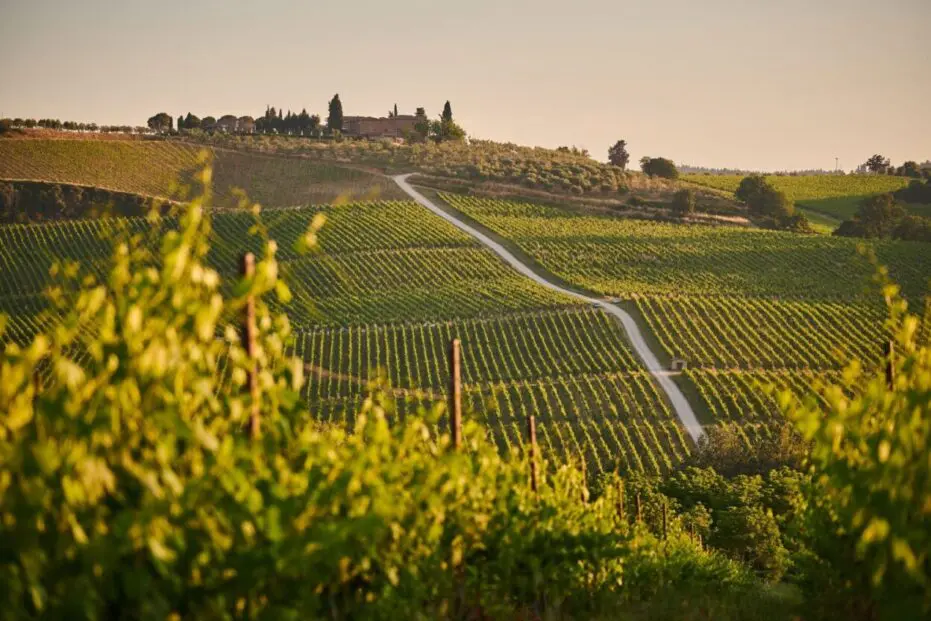
Titolo Aglianico
If the shape of Italy is seen as a boot, then Basilicata forms the arch of the foot. In wine terms, Basilicata is the second least productive region in Italy. It’s also Italy’s second least populous region.1
Most of Basilicata is mountainous, while less than 10% of the land is flat. Economic emigration has long been a part of its history, and its wild natural beauty and deep cultural heritage have been relatively inaccessible to tourism. Hence, this region remains one of Italy’s best-kept secrets. Basilicata has only one DOCG and four DOCs. Yet Aglianico del Vulture DOC/DOCG is one of Italy’s greatest red wines.
Monte Vulture is an extinct stratovolcano with a summit elevation of 1,326 metres, and the only volcanic peak in the region. Being inland and in the north of the region, it’s sandwiched between Puglia and Campania. Moreover, it’s the only one of Italy’s major volcanoes that lies east of the Apennines. Far from major tourist and population areas of Italy, this situation is unlike its more famous and very active brethren, the fearsome Etna and Vesuvius! The last eruption of Monte Vulture was some 40,000 years ago, and two picturesque lakes now occupy the summit caldera.
Aglianico del Vulture DOC/DOCG lies around the base of the volcano at 200-700 metres. It’s dedicated solely to this grape variety, and was created in 1971.2 There are 580 hectares of vines and 37 consorzio members, including Azienda Agricola Elena Fucci.
Elena Fucci

Elena Fucci
Elena Fucci founded her winery in 2000, at a time when her family were thinking about whether to sell the six-hectare vineyard called Titolo that her grandfather, Generoso, had bought in the 1960s. This six-hectare vineyard is on the highest part of the Monte Vulture DOC, at 600 metres above sea level, and is named after the Solagna di Titolo contrada, or Cru.
Altitude is a key factor here, bringing exposure to the winds, cooler temperatures, and considerable diurnal variation.
The mineral-laden “pozzolano” volcanic soil is composed of visible horizontal layers of lava, ash, and clay. Titolo faces south-south-east, the perfect orientation to catch the sun in early morning while avoiding the afternoon heat. This area is also known for its abundant sunshine. All these factors create perfect conditions for farming Aglianico.
The grapes were grown but always sold to other producers, only keeping enough to make wine for family consumption. When it looked like the vineyard would be sold, Elena had an epiphany. She decided (at age 19) to change direction from studying architecture to undertaking a degree in oenology and viticulture, and then create a wine from this place.
With the support of her family, her vision was for one grape, Aglianico, to make a single extraordinary “Cru” wine, namely Titolo. The resulting wine was remarkable, and the acclaim for Elena Fucci as one of Italy’s great winemakers rightly followed.
Titolo and Titoli
In the ensuing years, a modern underground winery was hewn underground. Some new vineyards were added, e.g. for white wine. However, the core proposition remains Titolo, where the vines are now between 45 and 70 years old, and so naturally low yielding.
Meanwhile, the single Titolo wine has become the plural Titoli, as it’s now made in slightly different versions.3
Titolo “Classico” Aglianico del Vulture DOC is the original wine and is featured here. It’s the most representative, with around 25,000 bottles made each year. Then there’s a DOC version made in terracotta Amphora (800-900 bottles). There are small amounts of Superiore and Riserva made from the oldest 70-year-old vines, each having longer maturation, of three and five years respectively (DOCG). Then there were special bottlings celebrating the 20th and 25th anniversaries. There’s now a Rosé (Titolo Pink Edition). I’ve seen a Titolo vermouth, plus Titolo grappa and an Extra Virgin Olive Oil called Titolio! There is no sparkling Aglianico wine made here, perhaps that could offer another future challenge!
Meanwhile, Elena Fucci’s philosophy shows respect for nature and sustainability. Indeed, the vineyards and land have never been treated with chemicals and are certified organic. The underground winery has an ecological design, uses recycled materials and minimises energy use.
Titolo, “Classico”, Aglianico del Vulture DOC, Basilicata, Italia, 2019. 14%
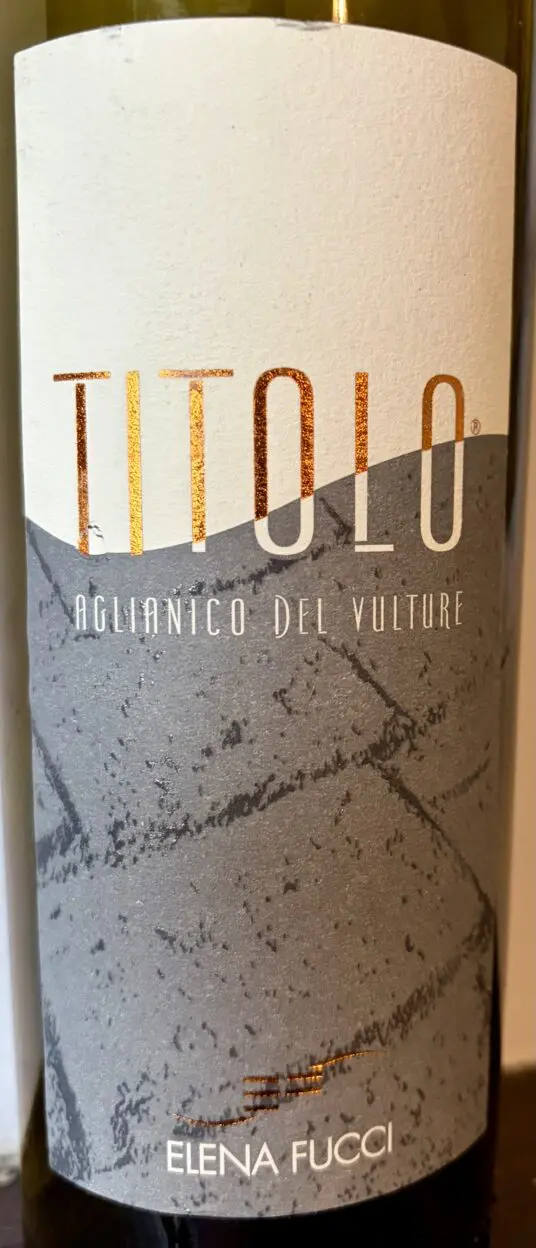
Titolo “Classico”, Elena Fucci
Technical
2019 was a classic, balanced vintage. The winter was less severe than usual, with less abundant but more frequent rain in spring and summer. The Aglianico grapes were manually harvested from Titolo on October 23rd, from Guyot-trained vines 45-70 years old. Fermentation was in stainless steel, of whole berries with “scratched” skins that help release the juice from the thick skins. Maturation was for 24 months in 2,000 litre French oak barrels (50% new) followed by 12 months in numbered bottles, sealed with natural cork. This bottle was number 12,001 of 26,122.
Tasting
Decanting is essential; two hours seemed about right for this still youthful wine. There’s an intense ruby colour, with a little garnet reflection. The aromas are subtle and gradually reveal themselves; dark fruits such as blackcurrant, plum and damson, then scents of earth and brown spices like cinnamon.
The palate is all about poise and elegance. The acidity keeps everything fresh, the tannins are elegant and without a trace of rusticity, while the alcohol is the perfect weight to convey the complexity of flavours and adds a full, rounded texture. It’s dense and intense: cherry, damson and currants with hints of tobacco, rosemary and cinnamon. A subtle savoury undertow offers something meaty, almost bloody. Finally, an orange peel note gradually appears on the long, persistent mineral finish.
Very complete, yet with still more to come for those willing to wait. As for longevity, this wine will still be drinking well into the 2040’s.
Food
The culinary heritage of Basilicata is truly cucina povera, for which Aglianico del Vulture is well suited. Try pork and lamb dishes, cheeses, and grilled or roasted vegetables. Hence, slowly braised pork cheeks in red wine (don’t use Aglianico!) proved to be a fabulous winter match. This wine is also delightful with Caciocavallo Impiccato cheese, grilled outdoors over an open fire on a balmy summer’s night.
UK Stockists
UK Stockists include Lay & Wheeler, £45.00. Several older vintages are also available there for those who prefer maturer wines or who like to compare vintages. The 2019 was chosen for this article as a classic vintage, one combining the power of 2017 and the elegance of 2018. Other stockists have the later 2020, which may be a little cheaper but still requires a little more cellaring.
And Finally
The last words in this article are rightly Elena’s.“My interpretation of the territory is defined by industry insiders as modern but not modernist. Modern for being able to understand the real needs of the Aglianico variety in terms of maturation and ageing, but always without changing the characteristics of the fruit that the vineyard yields in this wonderful corner of Italy”.
Location
Azienda Agricola Elena Fucci
Contrada Solagna del Titolo
85022 Barile
Potenza (PZ)
Basilicata
Italy
What3words Location
Notes
- In Italy, only the Valle d’Aosta region has a lower population density and produces less wine than Basilicata.
- Aglianico del Vulture DOC stipulates that vineyard elevation must be between 200 metres and 700 metres above sea level. Only Aglianico is allowed. The minimum ageing for the still red wine is 9 months. A sparkling wine is also allowed, in Brut and Extra Dry Spumante forms, it must be Metodo Classico with a minimum bottle ageing of 9 months. The Superiore DOCG was created in 2010, and is a red wine selection only, with lower maximum yields. This stipulates a minimum ageing of three years, including 12 months in barrel and 12 months in bottle. In addition, the Superiore category also has a Riserva level with a minimum ageing of five years, with 24 months in barrel and 12 months in bottle. There are no white or rosé categories. Nor is there a “Classico” zone or any other subzones that would add unnecessary complications.
- Titolo Classico and Titolo by Amphora are both DOC, while Titolo Superiore and Riserva are DOCG. As there is no DOC/DOCG for the Titolo Rosé, this is classified as an IGP Basilicata Rosato.